Home / Features / Tasks and activity
Tasks and activityTask Queues and Procurement Activity Records
A queue for today, a record for years later
Two things people need from the same underlying data. What is on me right now, and what happened eighteen months ago. Tasks answer the first, the activity record answers the second.
The same actions, read two ways
A task queue is about the next hour. An activity record is about a question somebody asks long afterwards. Both come from the same underlying events, which is why neither needs maintaining separately.
A task list showing everybody's work is a list people stop opening. Yours draws from the awards you own, the reviews waiting on you and anything assigned to you directly.
- Awards you own
- Reviews awaiting your decision
- Tasks assigned to you by colleagues
- Sorted by due date and priority
Unassigned and overdue items are visible more broadly, because work with no owner is exactly what disappears until somebody asks about it.
- Unassigned tasks surfaced rather than hidden
- Overdue items flagged clearly
- Nothing depending on somebody remembering
- Chasing done by the system
Records assembled after the fact are the weakest kind of evidence. Logging each action at the moment it occurs is what makes the sequence provable later.
- Uploads, approvals and completions all logged
- Each carrying a name and a timestamp
- Scoped to the award, modification and phase
- Not editable after the fact
Completing a task recalculates phase progress and moves the board card, so a single action updates the views everybody else is looking at.
- Phase progress recalculated automatically
- Board cards moved for everyone
- Activity entry written at the same moment
- No separate status update to send
Task lists and audit logs, separately
Most organisations have both of these already. They are usually two different systems, neither of which fully works.
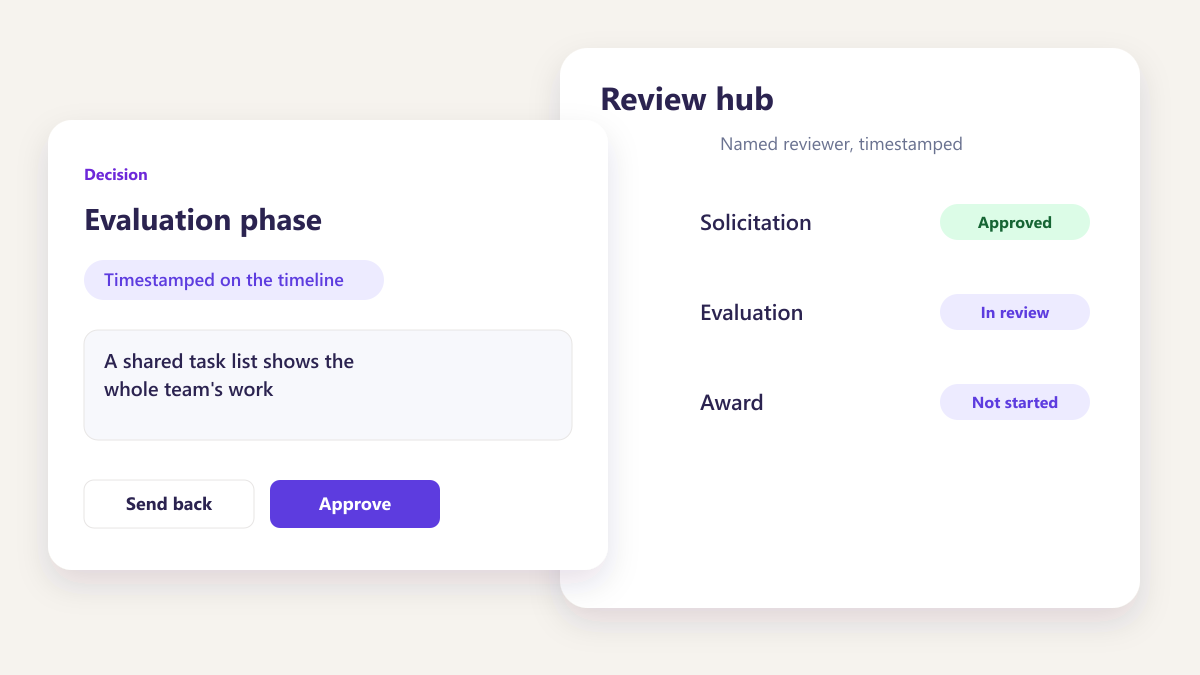
A list of everything
A shared task list shows the whole team's work, so finding your own means filtering every time, and most people stop opening it within a fortnight.
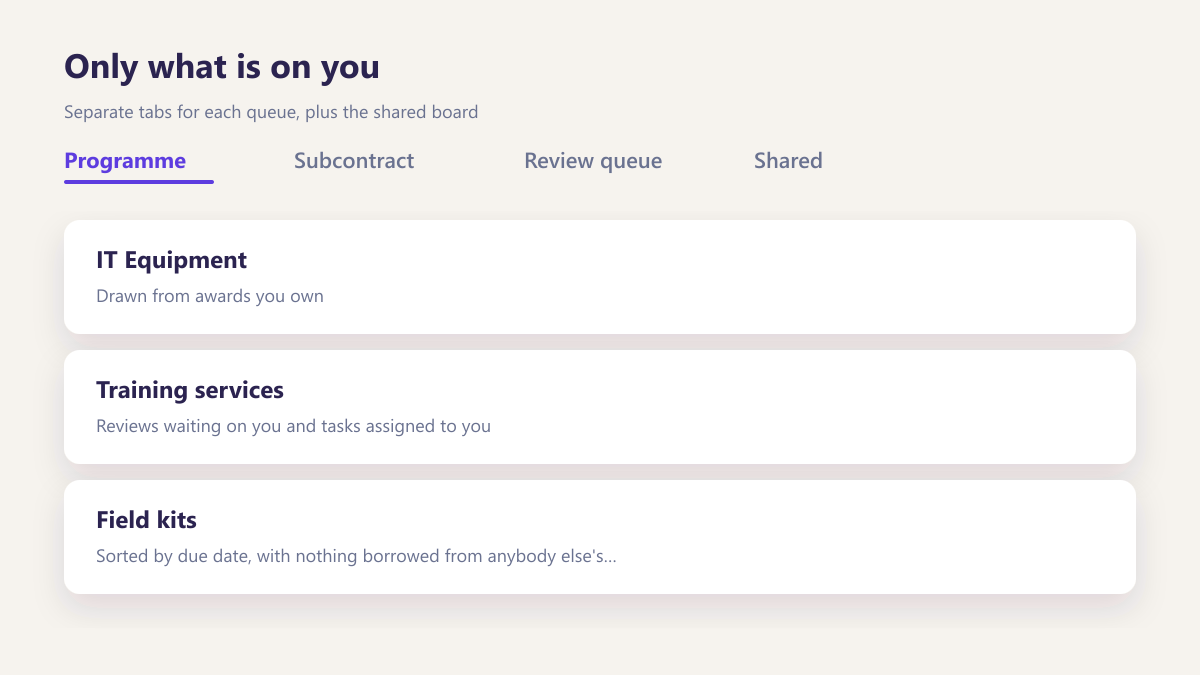
Only what is on you
Drawn from awards you own, reviews waiting on you and tasks assigned to you, sorted by due date, with nothing borrowed from anybody else's workload.
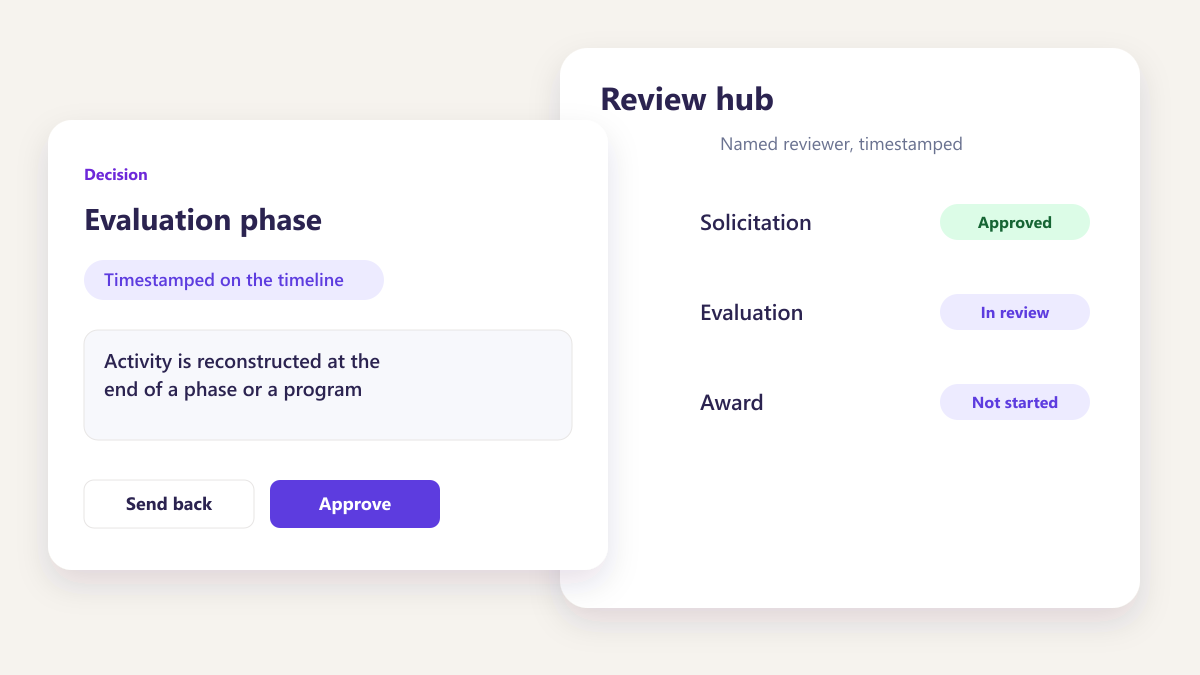
Written up afterwards
Activity is reconstructed at the end of a phase or a program, from memory and from whatever documents survived, which is the weakest form of evidence.
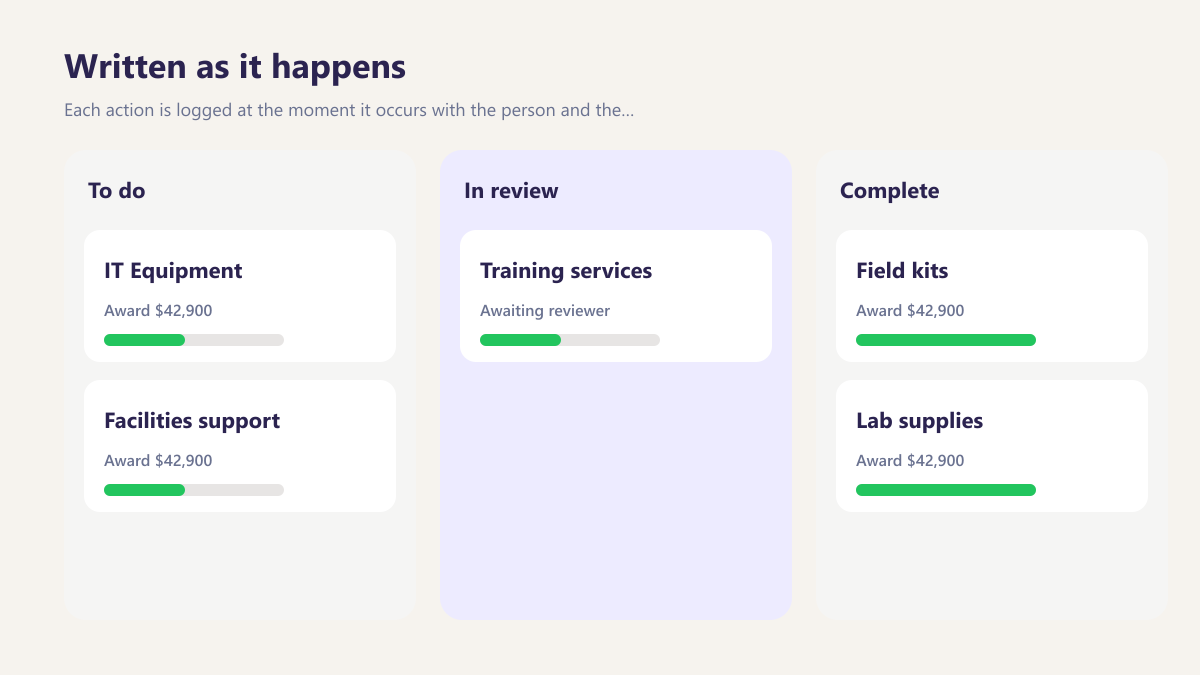
Written as it happens
Each action is logged at the moment it occurs with the person and the timestamp, so the order of events is a matter of record rather than recollection.
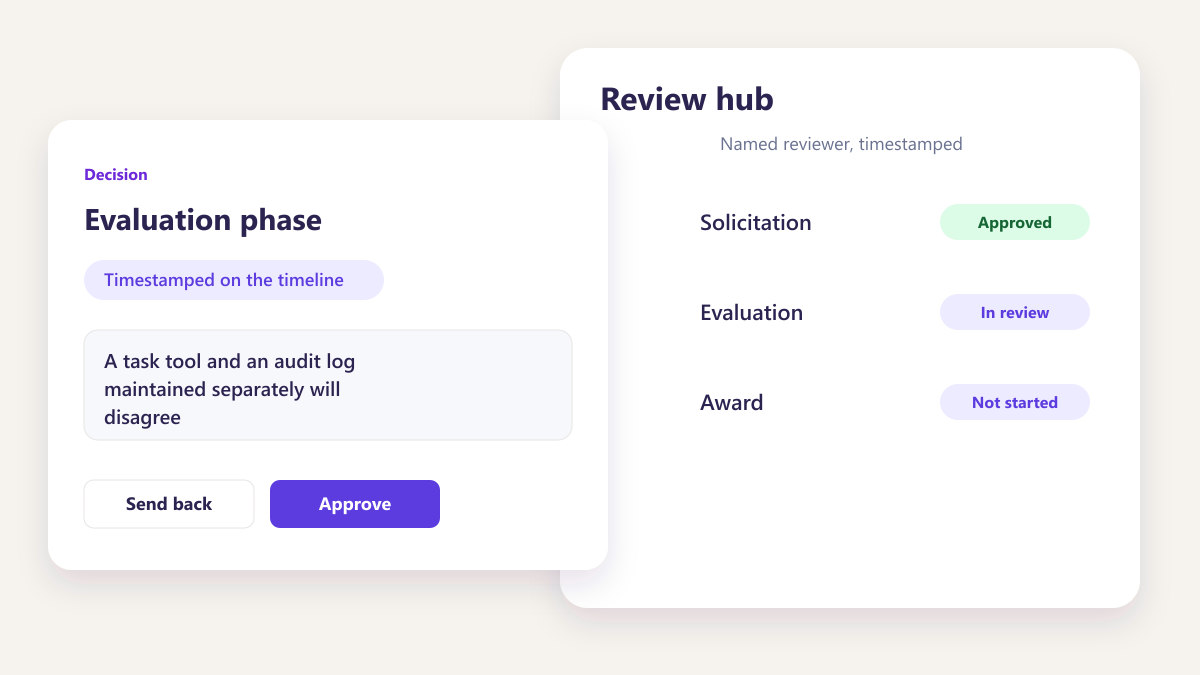
Two systems, drifting
A task tool and an audit log maintained separately will disagree, and reconciling them is work nobody has budgeted for.
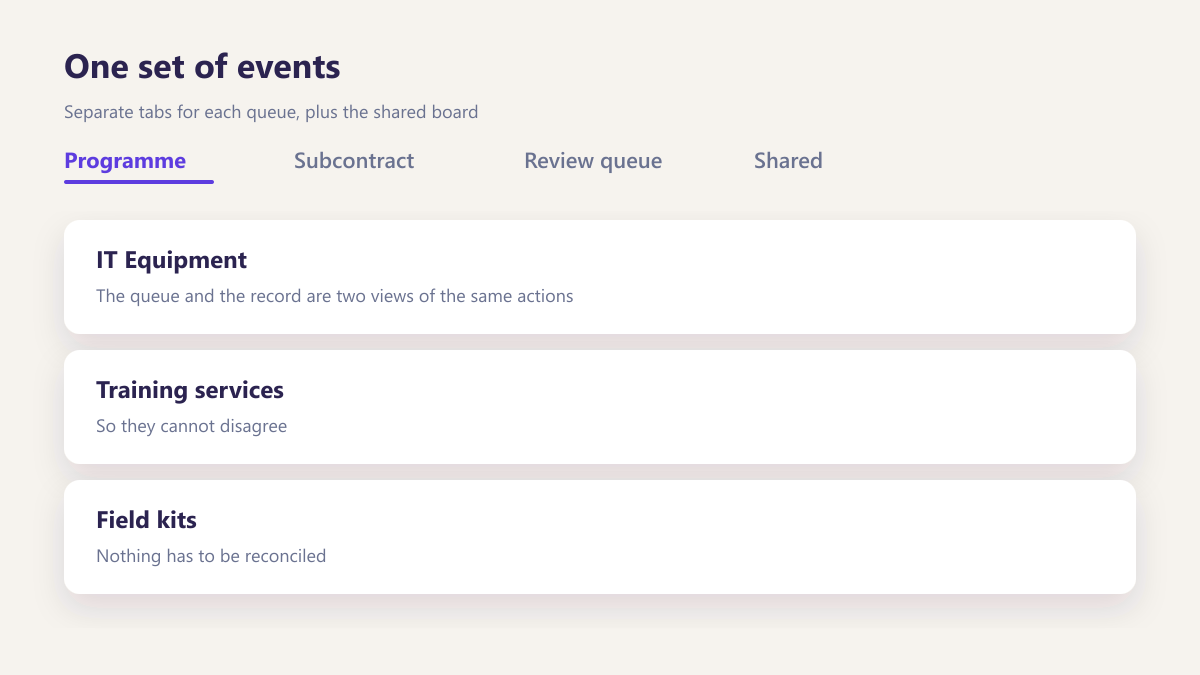
One set of events
The queue and the record are two views of the same actions, so they cannot disagree and nothing has to be reconciled.
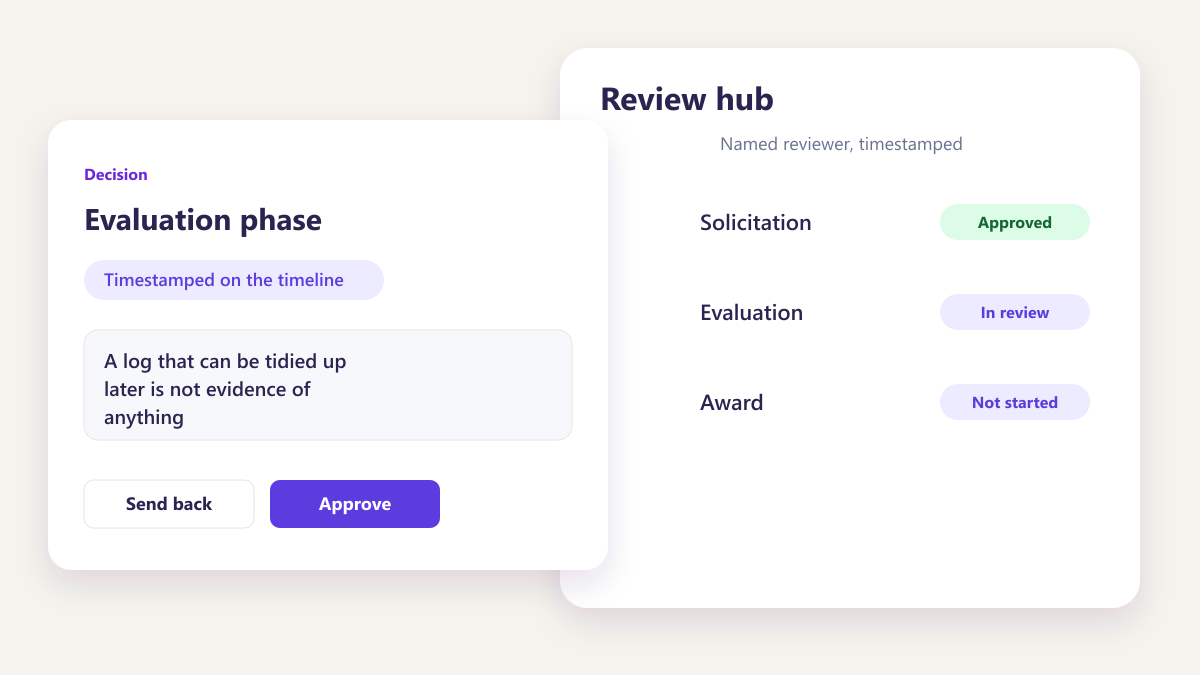
Adjustable after the fact
A log that can be tidied up later is not evidence of anything, and reviewers know it, which is why editable records get discounted.
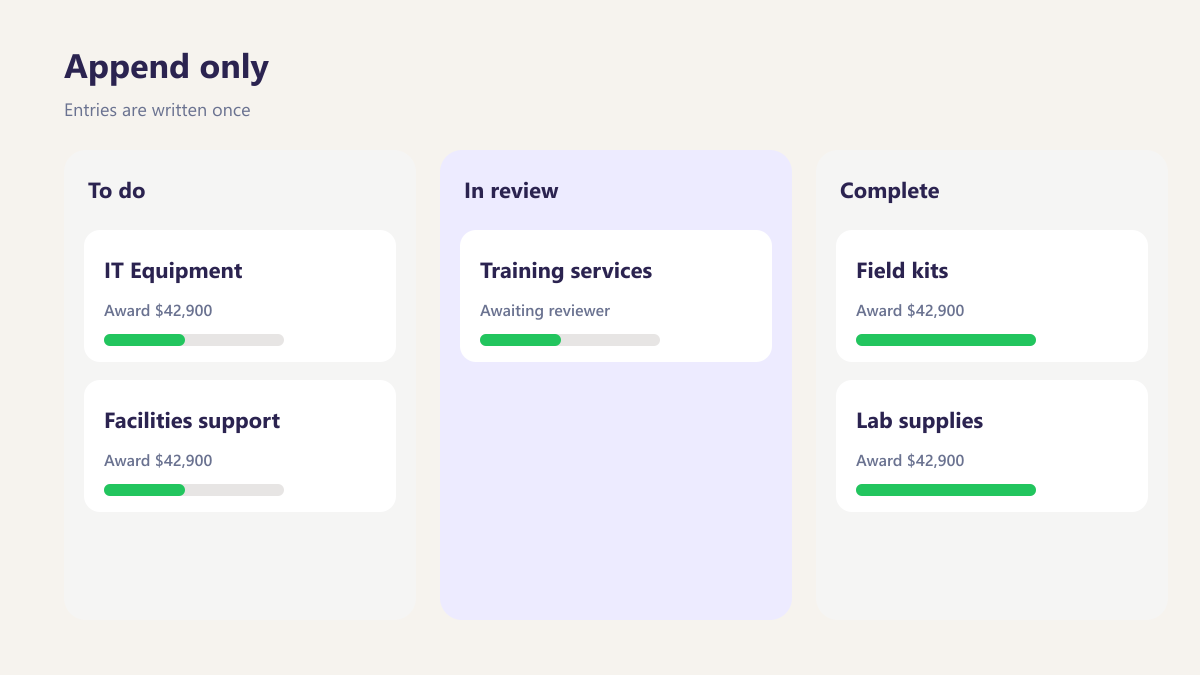
Append only
Entries are written once and left alone, which is the property that makes an activity record worth producing at all.
Three outcomes from one set of events
Three outcomes from one set of events
A list containing only your own work gets used daily. One containing the whole team's work gets abandoned in the second week, and then nothing is tracked at all.
- People actually open their queue
- Nothing sits quietly
- The sequence is provable
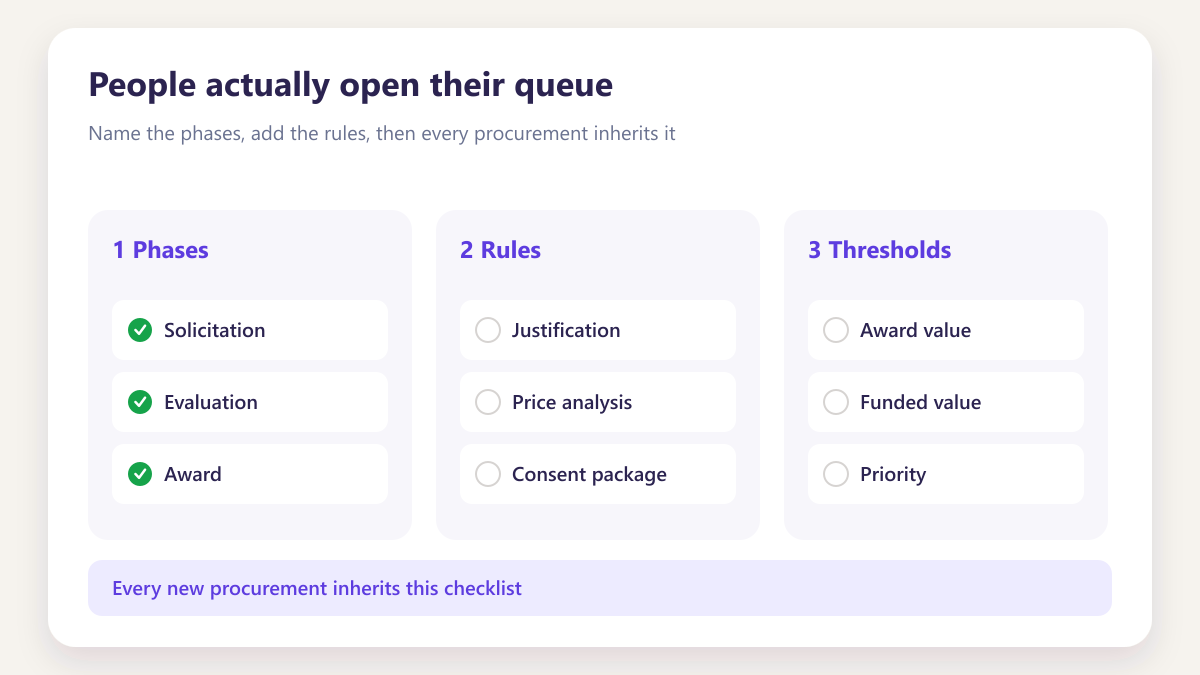
People actually open their queue
A list containing only your own work gets used daily. One containing the whole team's work gets abandoned in the second week, and then nothing is tracked at all.
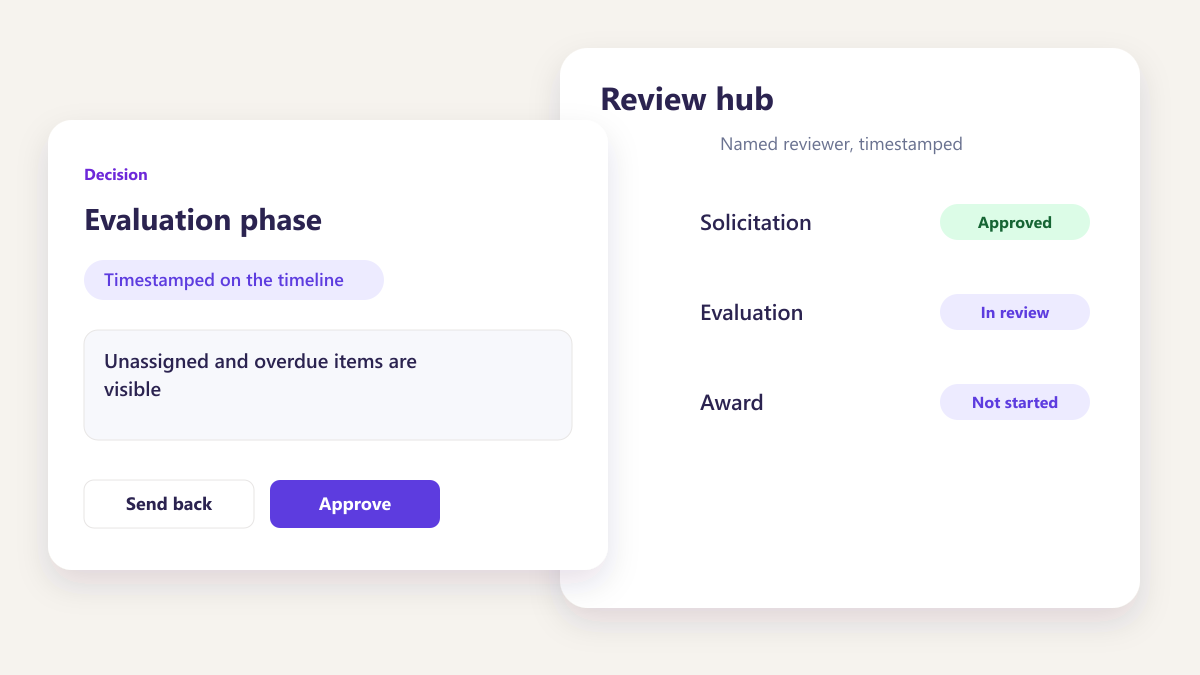
Nothing sits quietly
Unassigned and overdue items are visible rather than waiting to be discovered, which is how awards stall without anybody intending it.
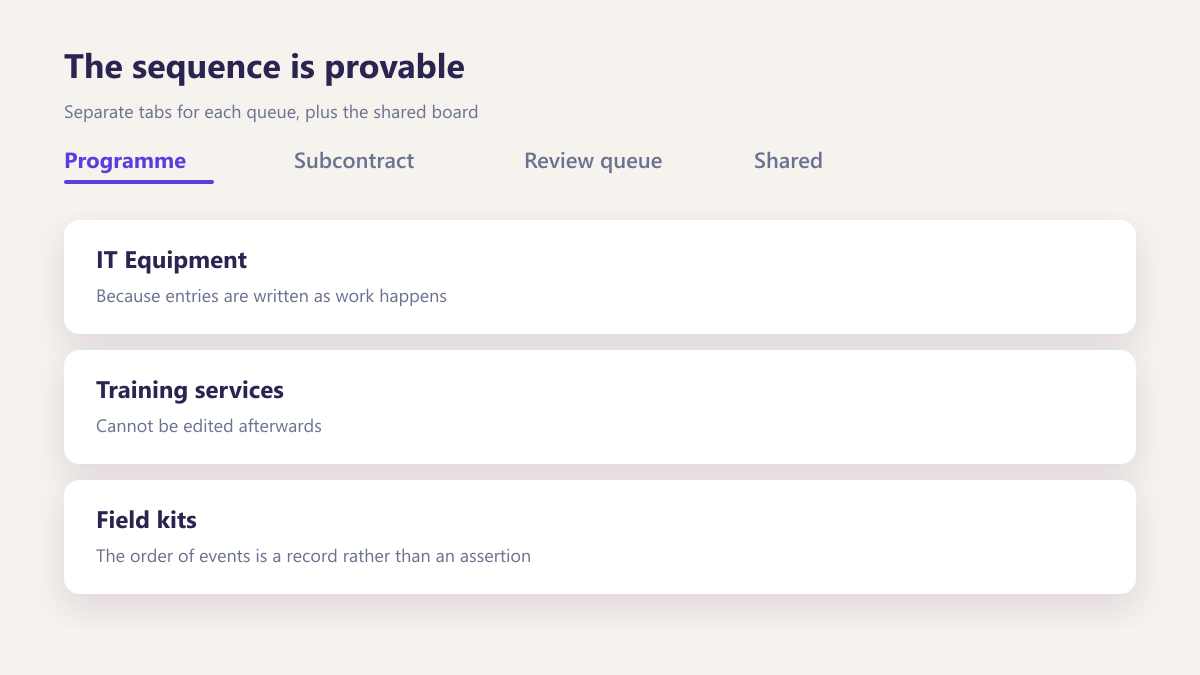
The sequence is provable
Because entries are written as work happens and cannot be edited afterwards, the order of events is a record rather than an assertion.
Six questions that arrive later
Six questions the record answers later.
Who did what, when, and on which version — the questions that arrive months after the work — are already on the timeline because the work left them there.
- Who acted and when, without reconstructing email
- Which document version a decision referred to
- What still sits open on the award today
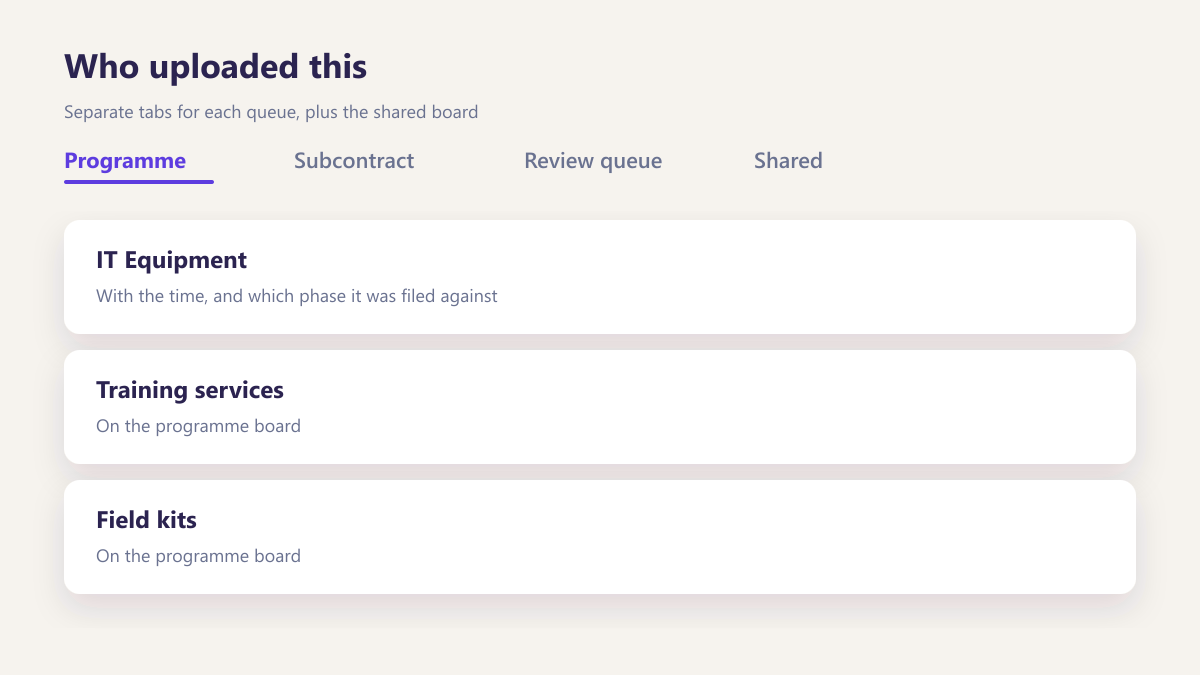
Who uploaded this
With the time, and which phase it was filed against.
Who approved it
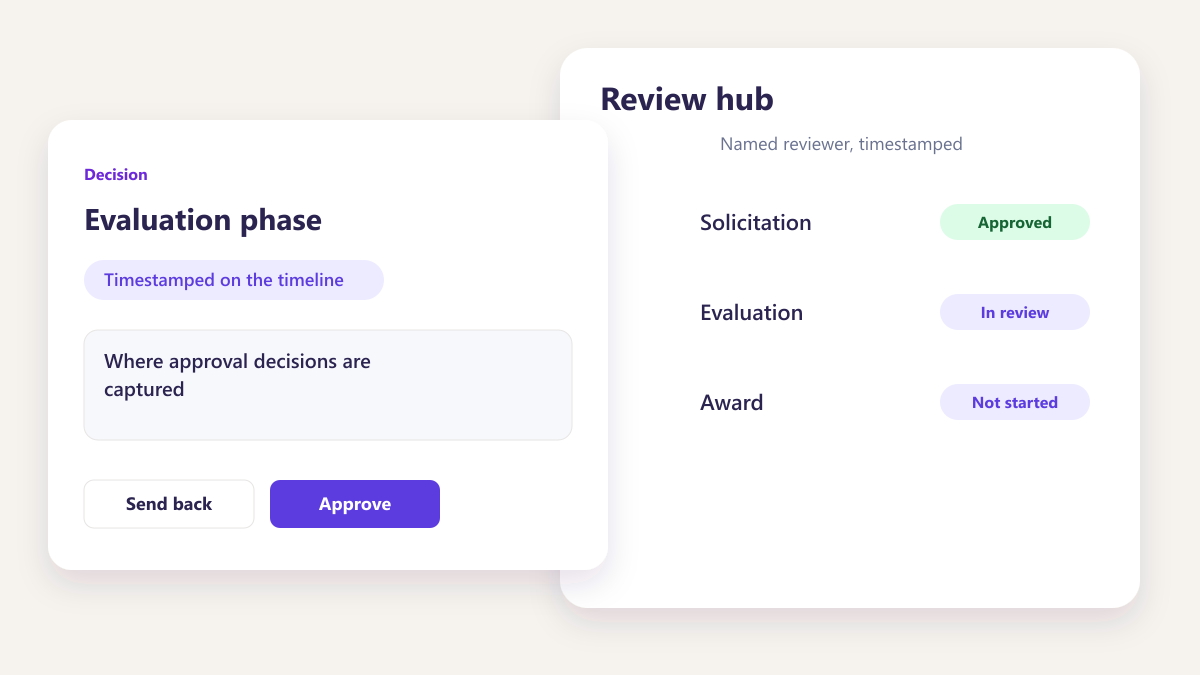
By name, and which version of the document they approved.
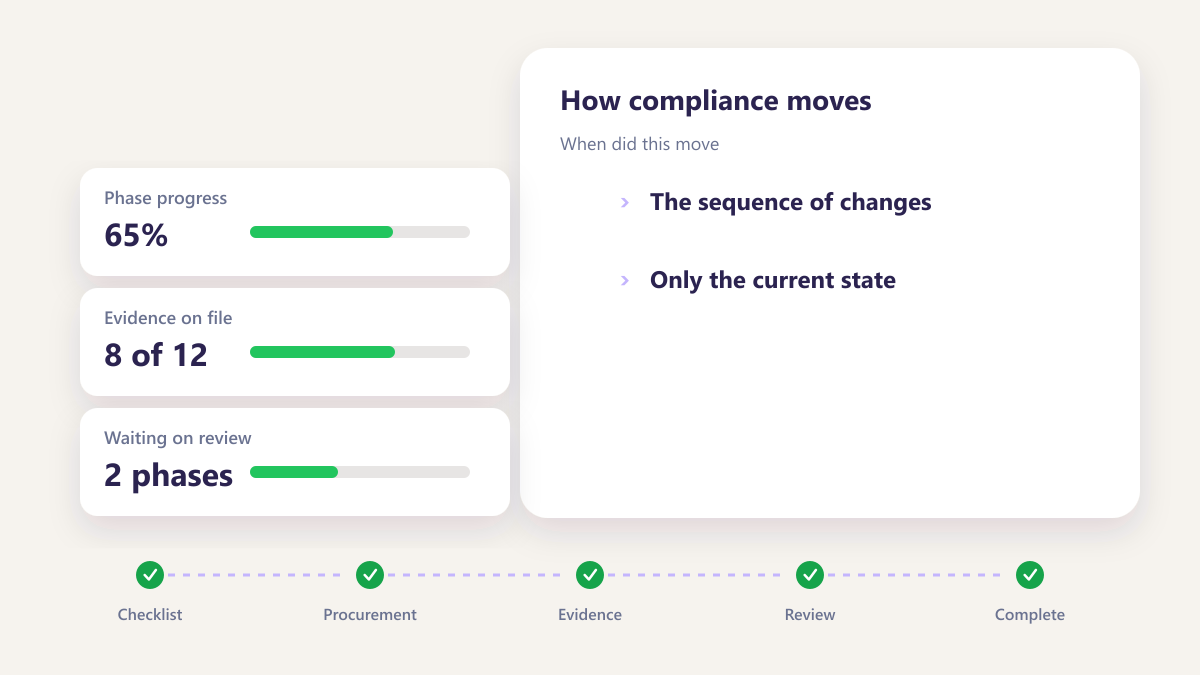
When did this move
The sequence of changes rather than only the current state.
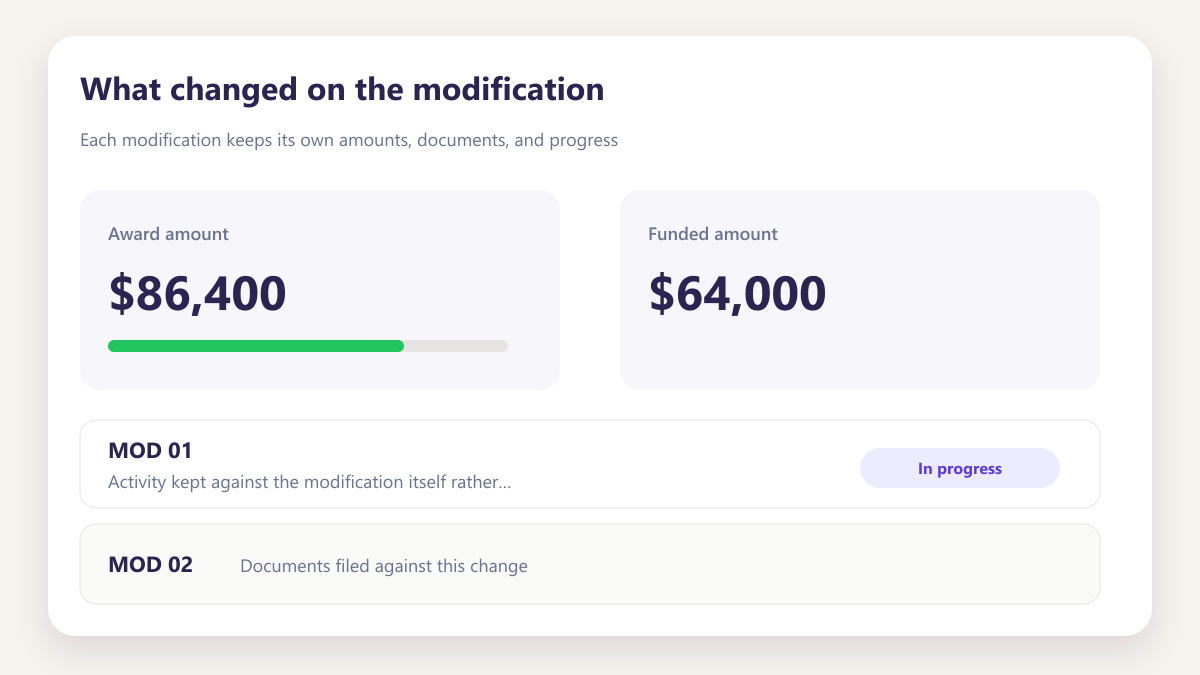
What changed on the modification
Activity kept against the modification itself rather than the parent.
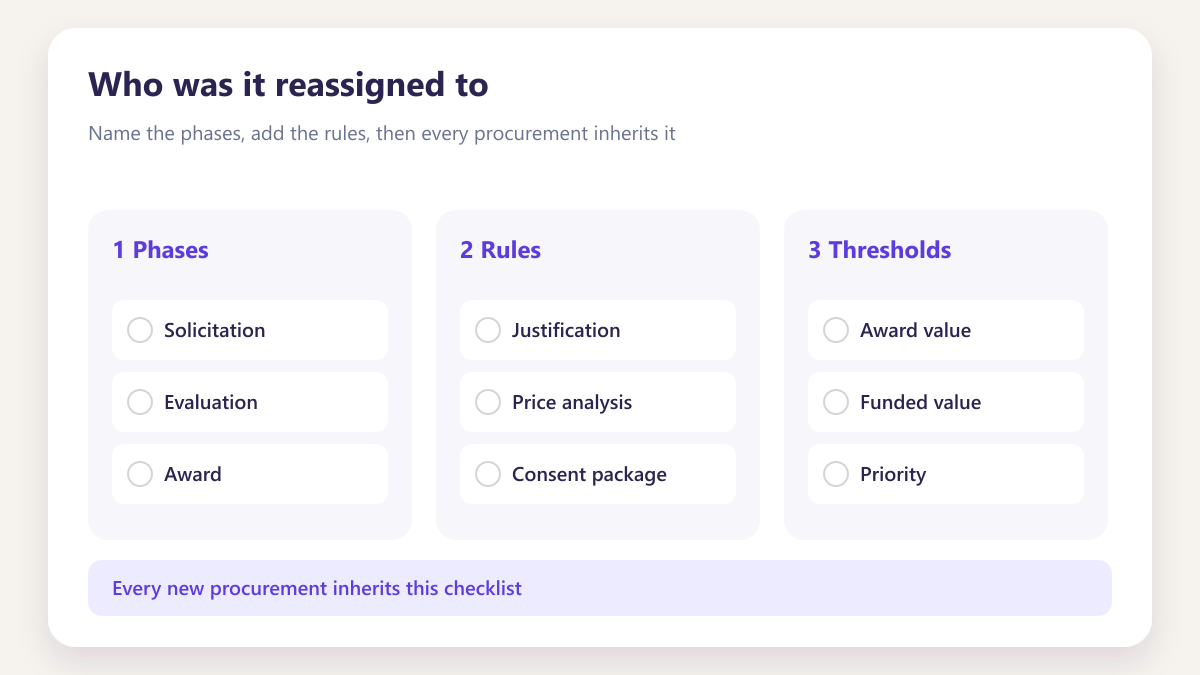
Who was it reassigned to
Both names retained, so handovers are visible.
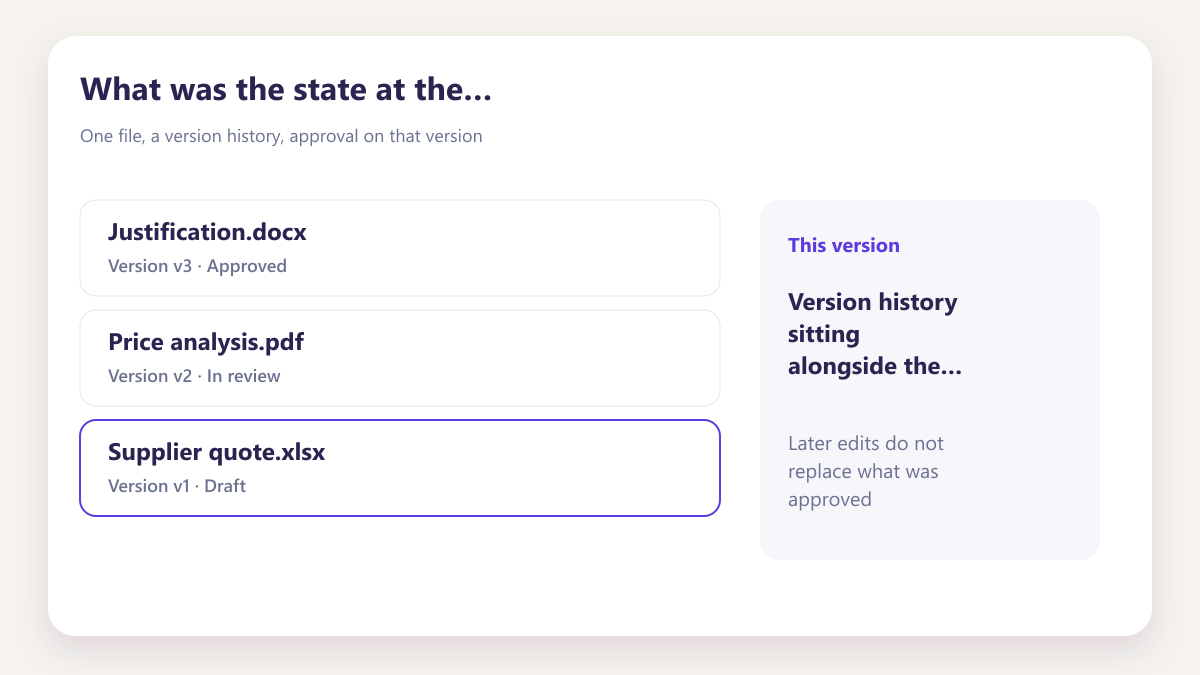
What was the state at the time
Version history sitting alongside the activity entry.
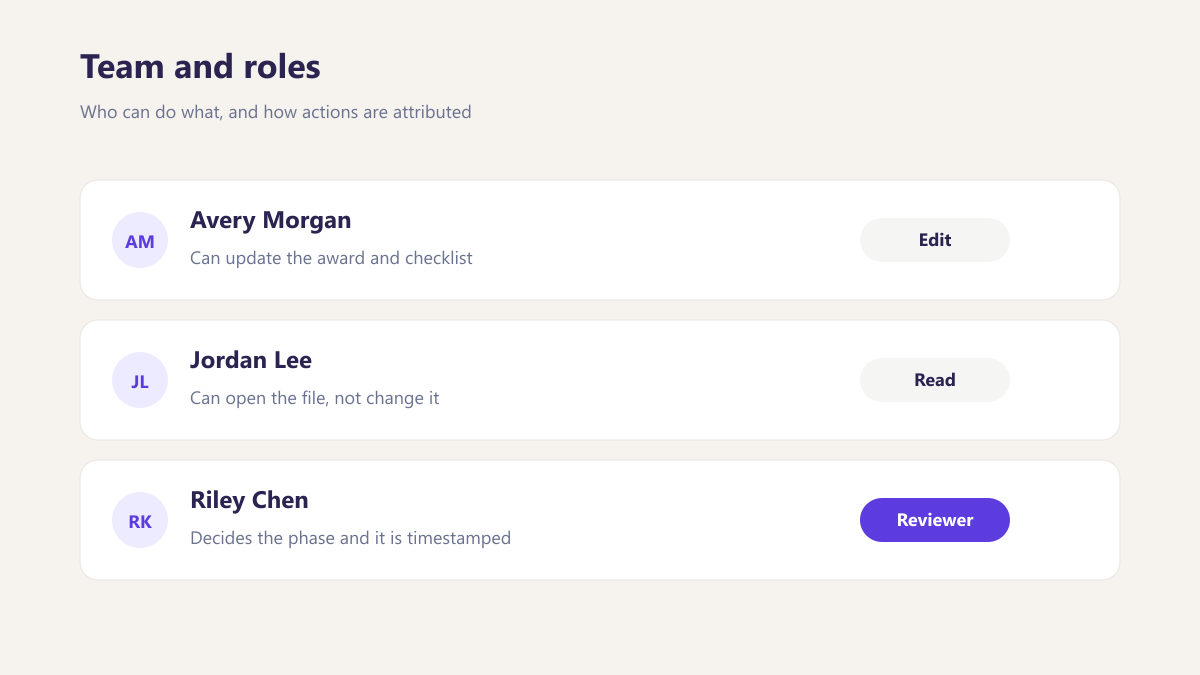
Four roles, two different needs
The queue
Opens it each morning to see what is due, what is overdue and what came back from review.
The queue
Sees only phases awaiting their decision, with cleared items dropping off as they work.
The record
Answers who did what and when without asking anybody or searching an inbox.
Both
Watches for work that has stalled, then looks at the record to understand why.
Questions about tasks and activity
What appears in my task queue?
Can I see other people's tasks?
What gets written to the activity record?
Can activity entries be edited afterwards?
Does completing a task update anything else?
How far back does the activity record go?
Can we export the activity record?
Other parts of the same workspace
See the activity record on a real file
Bring an award where somebody has already asked who did what. That is the case worth walking through together.
Book a demo