Home / Guides / Purchasing review checklist
GuidePurchasing System Review Checklist
What a review examines, area by area
Reviews work through your written policies and then through a sample of real purchase files. This is what each half looks at, and where contractors most often come up short.
A contractor purchasing system review examines both your written purchasing policies and a sample of actual purchase files tested against them. Defense reviews work from the criteria in DFARS 252.244-7001 and the DCMA guidebook; civilian reviews use the factors in FAR Part 44. Most findings arise in the files rather than the policies.
And where the weight actually falls
Teams routinely spend most of their preparation on the policy document and then fail on the files, which are what the reviewers spend most of their time in.
The two halves of a review
A review tests your written policies first, then pulls a sample of purchase files to see whether practice matches them.
- Policies are measured against the system criteria
- A file sample tests what buyers actually did
- Most findings come from the gap between the two
| Half | What is examined | Where contractors stand |
|---|---|---|
| Written policies | Whether policies exist, cover the topics the review addresses, cite current regulation and describe the process actually followed | Usually present. The common weakness is drift: accurate when written, describing something else now |
| Purchase files | A sample of real purchase orders and subcontracts, tested for the analysis, justification, approvals and flow-down evidence your own policy requires | Where most findings arise. A file can hold every document and still fail to explain the decision |
| Consistency | Whether files behave the same way across different buyers and different periods | The quiet test. Variation suggests the outcome depends on individuals rather than a system |
| Practice against policy | Whether what the files show matches what the policy says | The gap itself is what gets cited, rather than either half in isolation |
Four that recur across reviews
These are not exotic. They are the same four, and each is preventable at the point the award is placed.
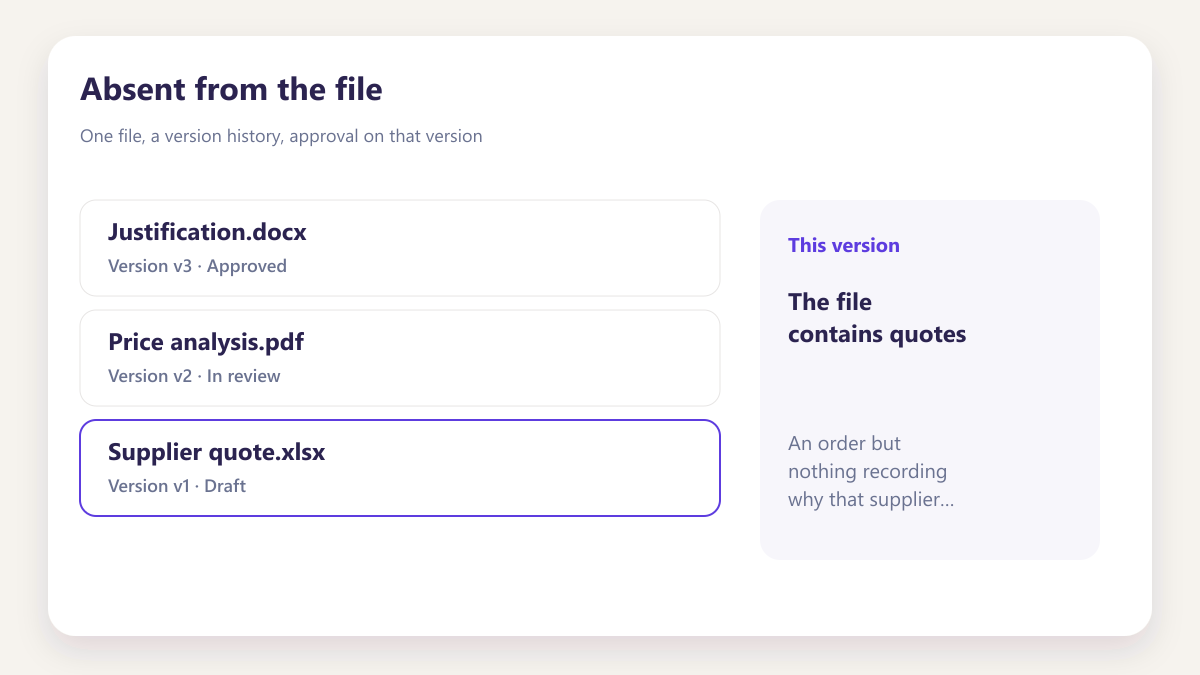
Absent from the file
The file contains quotes and an order but nothing recording why that supplier was chosen over the others, because it was obvious at the time.
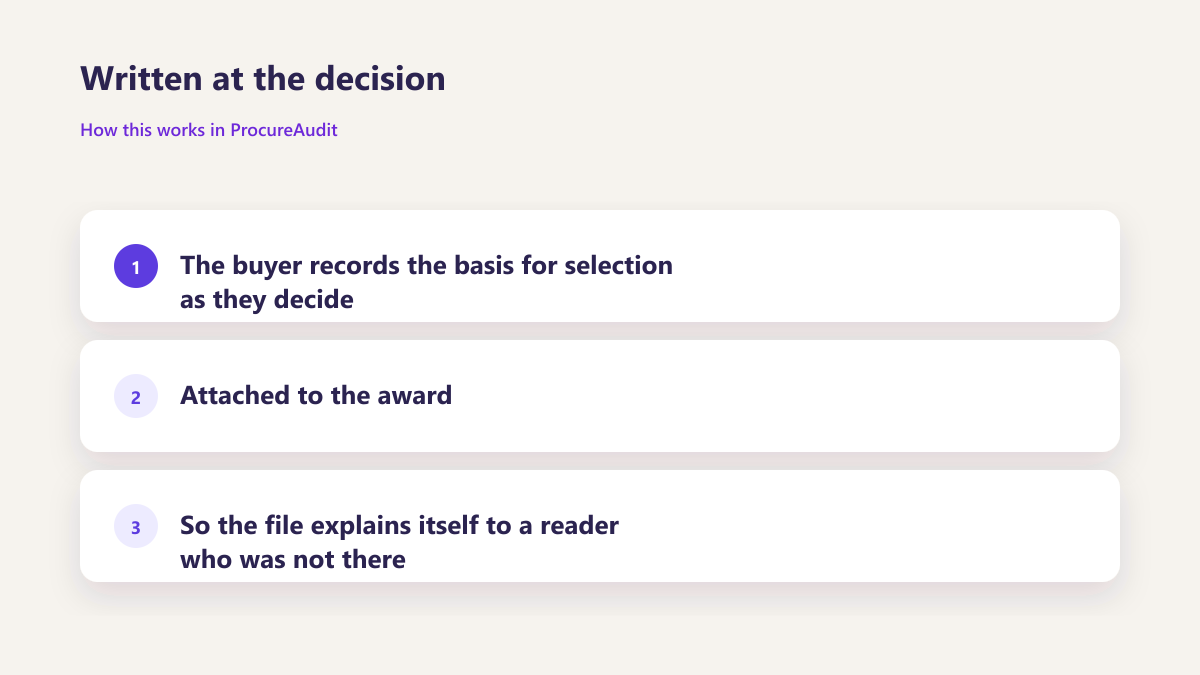
Written at the decision
The buyer records the basis for selection as they decide, attached to the award, so the file explains itself to a reader who was not there.
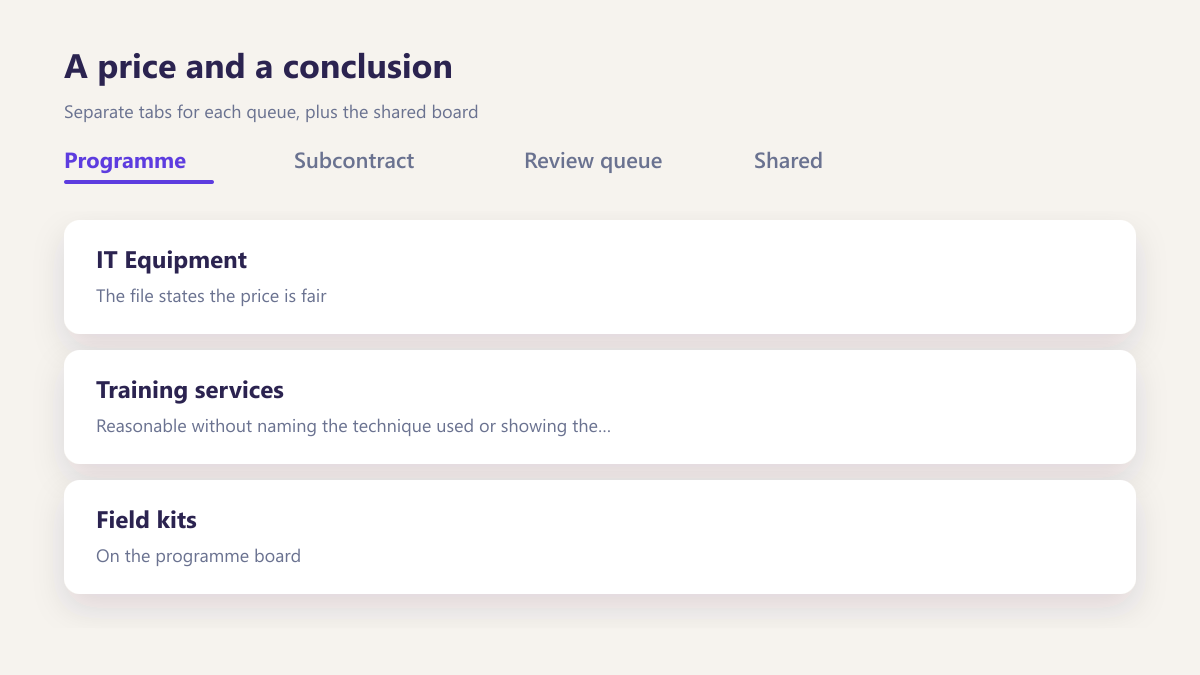
A price and a conclusion
The file states the price is fair and reasonable without naming the technique used or showing the comparators behind it.
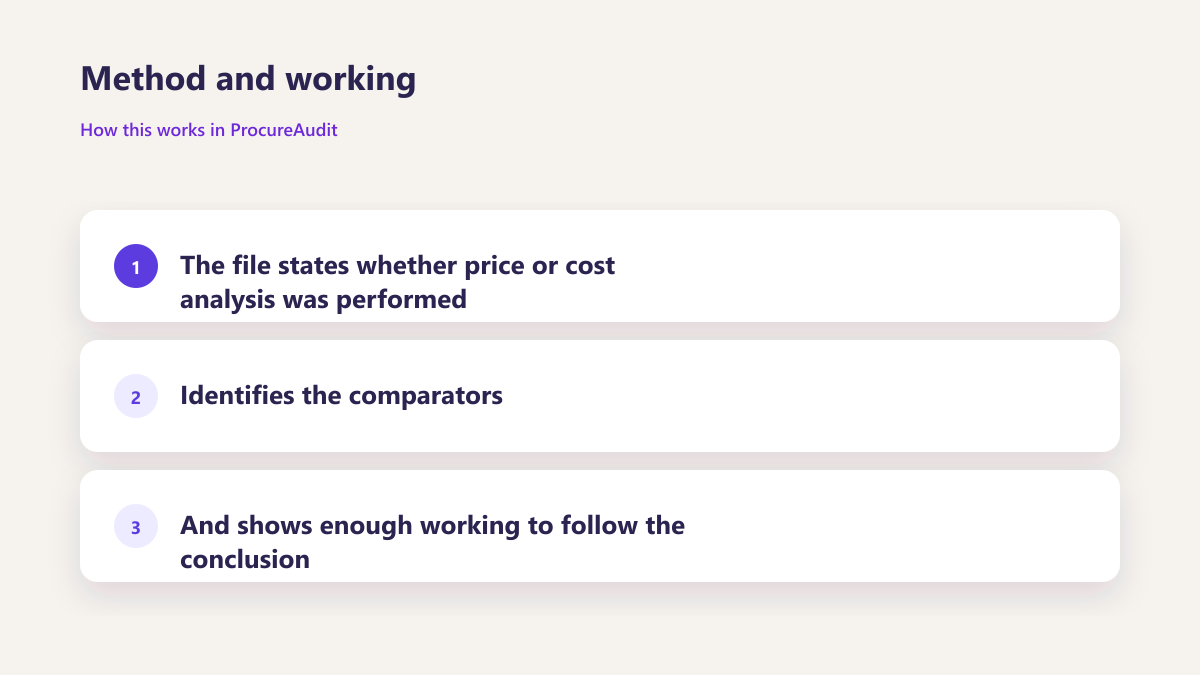
Method and working
The file states whether price or cost analysis was performed, identifies the comparators, and shows enough working to follow the conclusion.
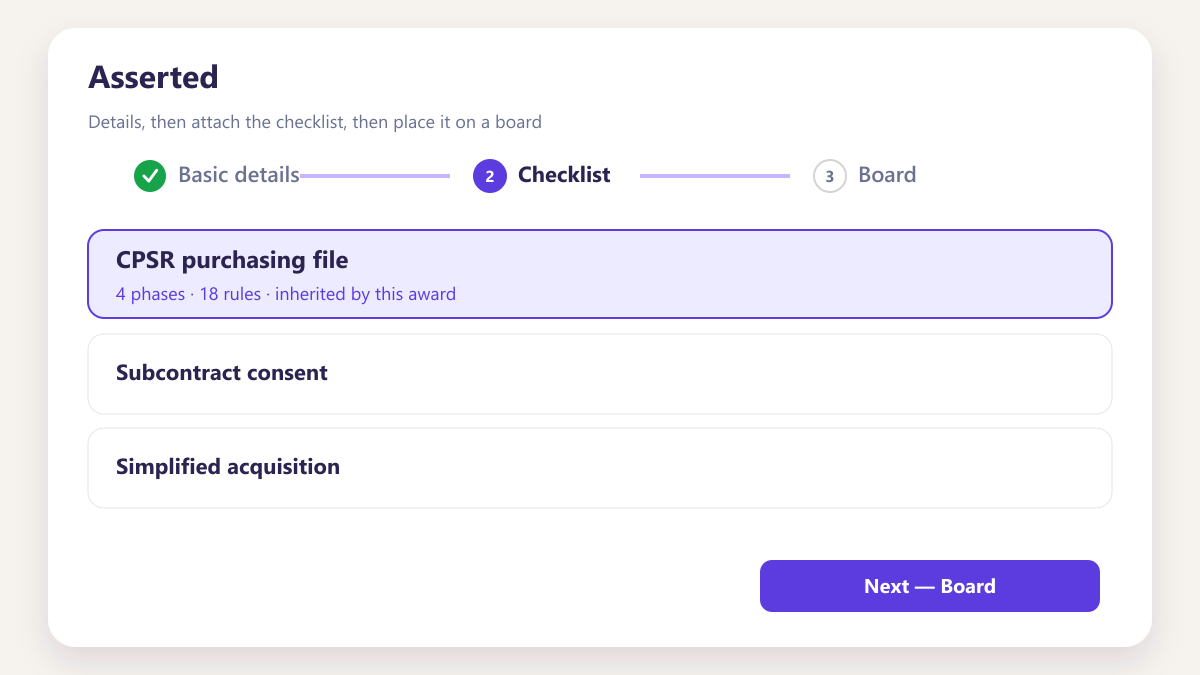
Asserted
The justification concludes that only one supplier could meet the need without naming who else was considered or why each was ruled out.
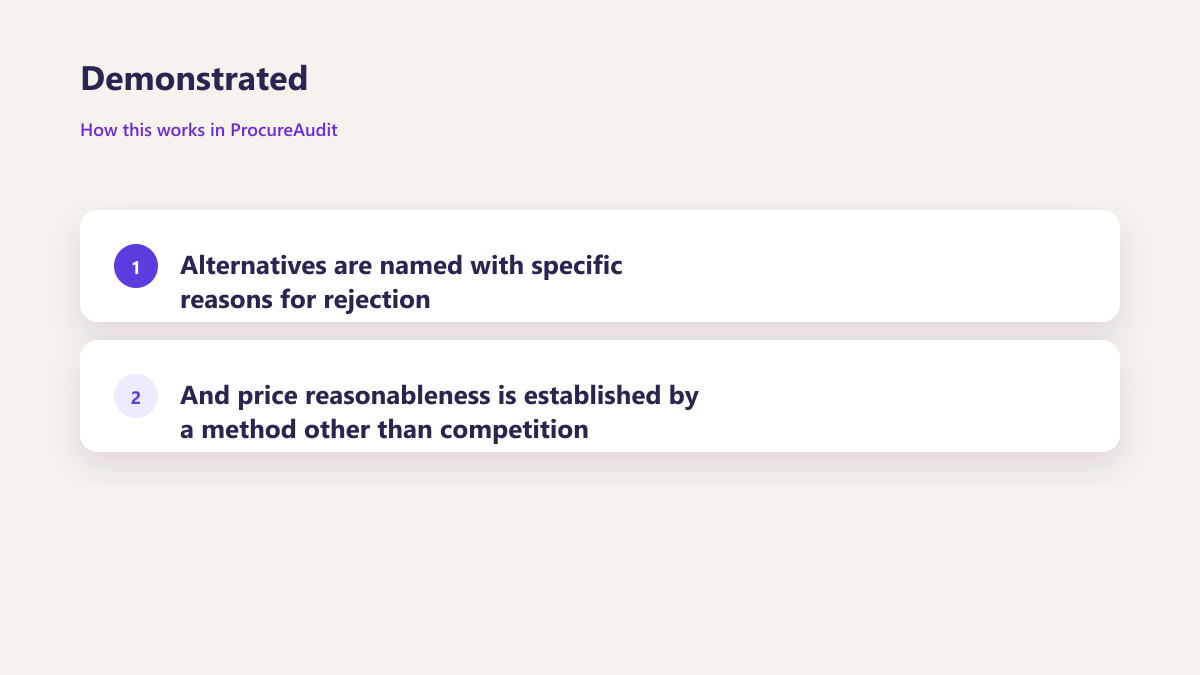
Demonstrated
Alternatives are named with specific reasons for rejection, and price reasonableness is established by a method other than competition.
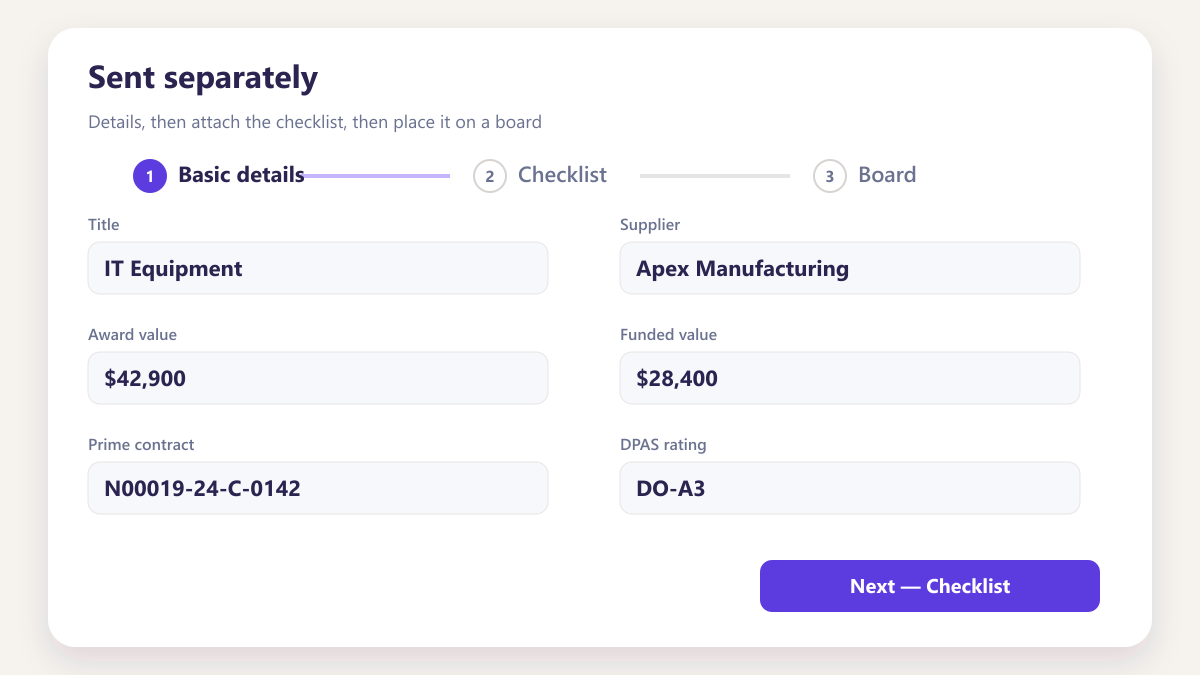
Sent separately
Clauses went out by email and the purchase file holds nothing showing what the subcontractor accepted or when.
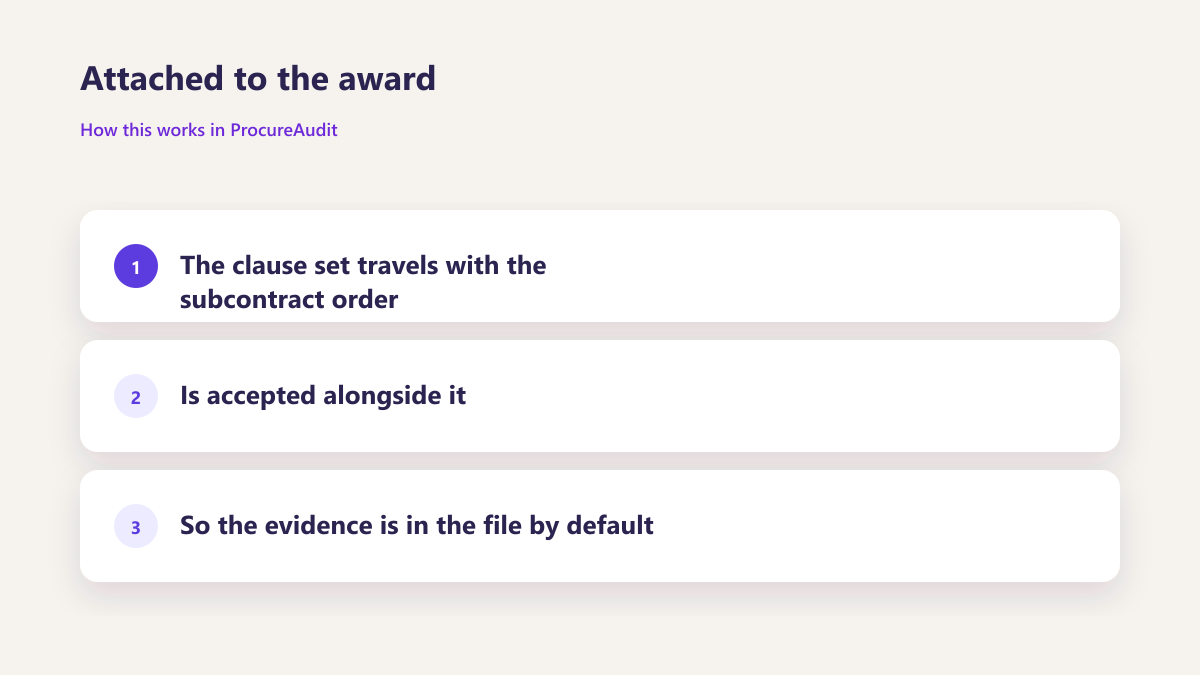
Attached to the award
The clause set travels with the subcontract order and is accepted alongside it, so the evidence is in the file by default.
Ten things to test on your own files first
Ten things to test on your own files first
Pull a handful of recent files and test each against the same ten points before a reviewer does.
- Competition sought, or a written justification
- Price reasonableness documented
- Approvals within delegated authority
| # | Test |
|---|---|
| 01 | Does the file say why this supplier was chosen, in words written at the time? |
| 02 | Does it name the alternatives considered, or only the one selected? |
| 03 | Does it state which price evaluation technique was used? |
| 04 | Are the comparators identified specifically rather than referred to in general? |
| 05 | Where competition was absent, is price reasonableness established another way? |
| 06 | Is the approver named, with a date, and at the right authority for the value? |
| 07 | Does the file show which clauses were flowed down and that they were accepted? |
| 08 | Where consent was required, does the evidence show it preceded the award? |
| 09 | Do modifications carry their own reasoning and approvals, or only the parent award? |
| 10 | Would a reader who was not involved reach the same conclusion from the file alone? |
Defense and civilian reviews apply different criteria. Confirm which framework applies to your contracts and work from the current published guidance.
Four steps that work
Sample your own files first
Pull ten recent awards and read them as a reviewer would rather than as the person who placed them.
Learn moreFix the process, not the sample
Tidying the specific files a reviewer might see is visible and does not survive a second sample.
Learn moreClose the policy to practice gap
The gap is what gets cited, so either the practice changes or the policy is corrected to describe reality.
Learn moreStart well before any notice
Reasoning nobody wrote down at the time cannot be recovered later, only reconstructed, and that reads differently.
Learn moreCommon questions about purchasing system reviews
What does a purchasing system review examine?
How many criteria are there?
Where do most findings come from?
Can we prepare by improving our policy document?
How far in advance should we start?
Should we tidy the files we think will be sampled?
What is the single most valuable change?
Other explainers and the pages they connect to
Run the checklist on ten of your awards
Bring them to the call and we will read them the way a reviewer would, including the ones you are confident about.
Book a demo