Home / Glossary / What is a CPSR
GlossaryWhat Is a CPSR? Contractor Purchasing System Review
What is a CPSR? And what triggers one
A Contractor Purchasing System Review is the government's examination of how a contractor buys under government contracts. It looks at your policies, your files and the decisions inside them, and its outcome decides how much purchasing autonomy you keep.
A Contractor Purchasing System Review, or CPSR, is a government review of how a contractor purchases under its government contracts. For defense work it is carried out by DCMA. Its purpose is to decide whether the contracting officer can approve your purchasing system, and an approved system means you keep the authority to place subcontracts without seeking consent each time.
Who runs it, and why it matters to you
The review is about your system rather than any single purchase. What it produces is a decision about how much purchasing autonomy you keep.
Who runs it, and why it matters to you
The review is about your system rather than any single purchase. What it produces is a decision about how much purchasing autonomy you keep.
- DCMA runs it for defense work; civilian agencies under FAR Part 44
- Crossing the sales figure triggers a risk assessment, not the review
- Approval decides whether you place subcontracts without consent
| Question | Answer |
|---|---|
| Who runs it | For Department of Defense work, the Defense Contract Management Agency. Civilian agencies run their own equivalent reviews under FAR Part 44. |
| What is reviewed | Your purchasing policies and procedures, and a sample of actual purchase files tested against them. |
| What triggers one | FAR 44.302 directs the contracting officer to assess the need when your government sales are expected to exceed $25 million in the next 12 months. DFARS 244.302 sets that figure at $50 million for defense contractors. Certain competitively awarded fixed price work and commercial items under FAR Part 12 are excluded from the calculation. |
| Is it automatic at the threshold | No. Crossing the figure triggers a risk assessment, not the review itself. Past performance and the volume, value and complexity of your subcontracts all feed the decision. |
| What is the outcome | The administrative contracting officer grants, withholds or withdraws approval of your purchasing system. |
| What if approval is withheld | You generally have to notify the contracting officer in advance and obtain consent before placing subcontracts, which slows down buying considerably. |
Policies on one side, purchase files on the other
The review has two halves, and contractors who fail usually do so on the second one rather than the first.
Policies on one side, purchase files on the other
The review has two halves, and contractors who fail usually do so on the second one rather than the first.
- Policies are checked for coverage and current regulation
- A sample of files is tested against your own policy
- Consistency across buyers is read as evidence of a system
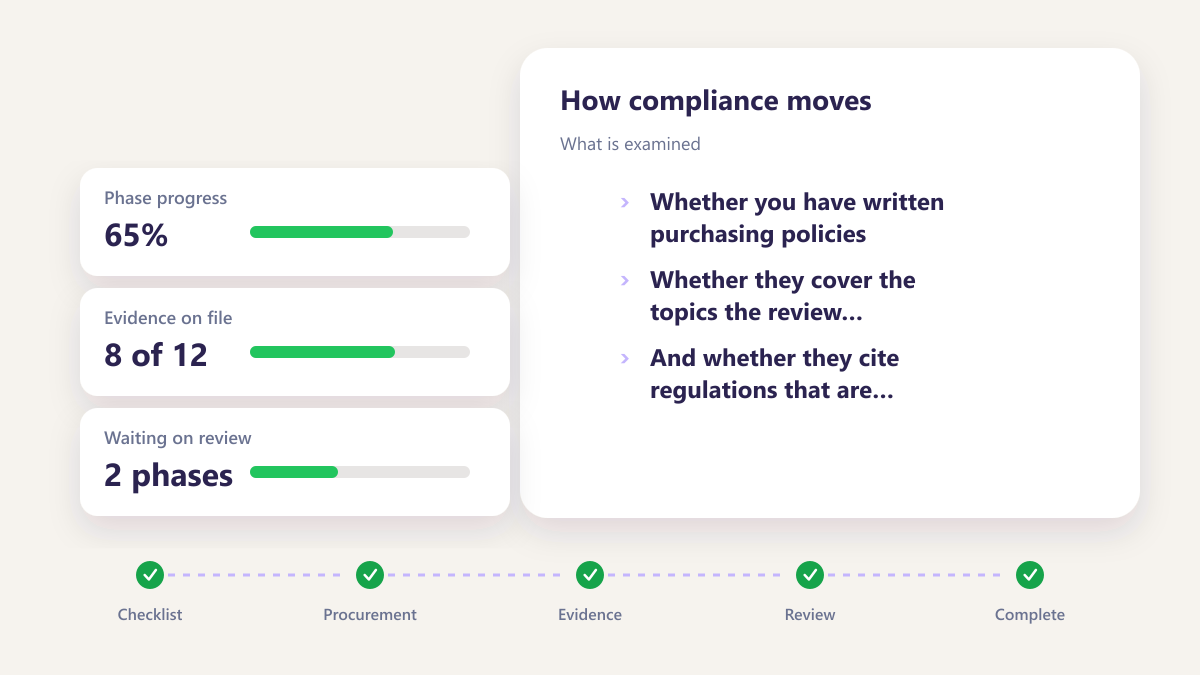
What is examined
Whether you have written purchasing policies, whether they cover the topics the review addresses, and whether they cite regulations that are still current.
Where it goes wrong
Policies that were written once and never revised, that cite superseded regulation, or that describe a process the team has quietly stopped following.
What is examined
A sample of actual purchase orders and subcontracts, tested to see whether each one contains the analysis, justification and approvals your policy requires.
Where it goes wrong
Price or cost analysis missing, sole source justifications that assert rather than demonstrate, flow down clauses incomplete, and reasoning that was never written down at the time.
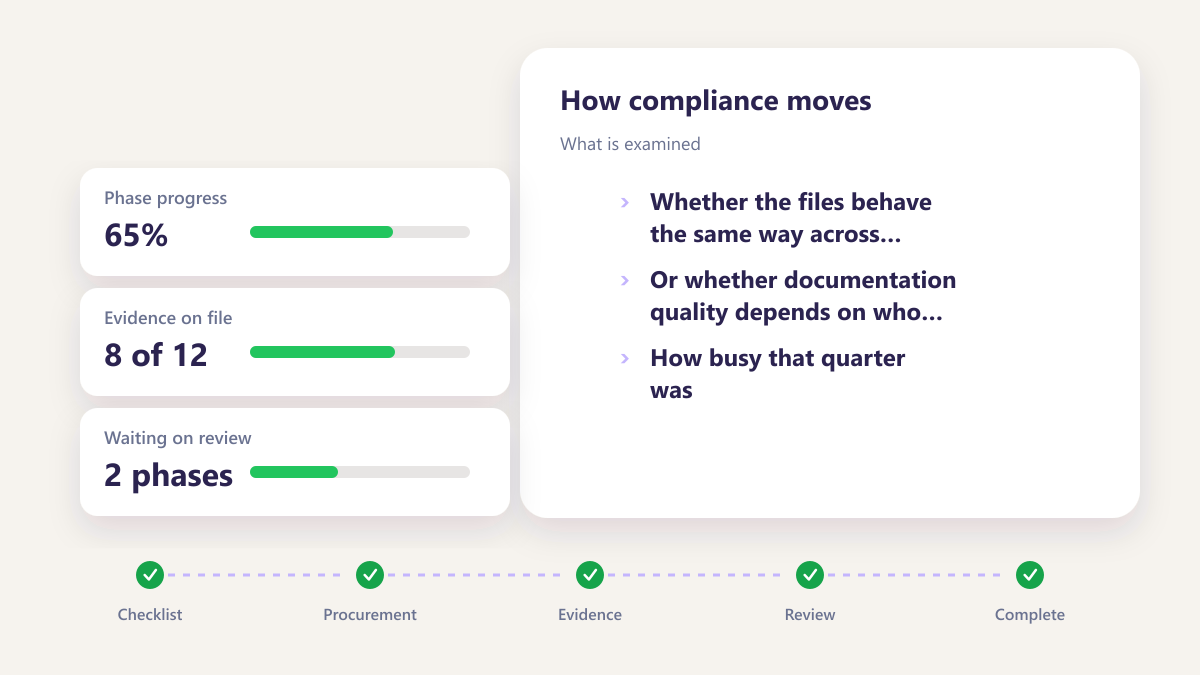
What is examined
Whether the files behave the same way across buyers and across time, or whether documentation quality depends on who placed the order and how busy that quarter was.
Where it goes wrong
One buyer documents thoroughly and another does not, or standards visibly drop in the busiest months, which suggests the system depends on individuals rather than process.
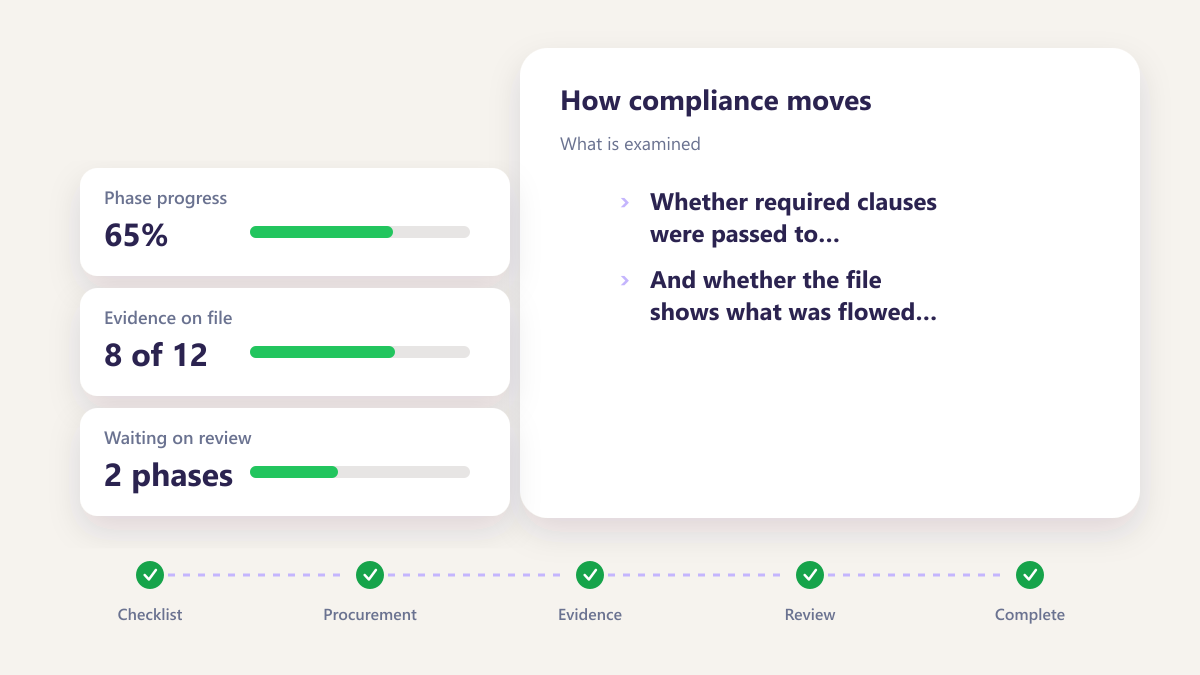
What is examined
Whether required clauses were passed to subcontractors, and whether the file shows what was flowed down on each award.
Where it goes wrong
Clauses sent by separate email with nothing in the purchase file recording what the subcontractor accepted or when.
Different criteria, similar purpose
| Defense contractors | Civilian agency contractors | |
|---|---|---|
| Primary clause | DFARS 252.244-7001, which sets out 24 system criteria | FAR 52.244-2, with the factors at FAR 44.202-2 |
| Assessment threshold | $50 million expected government sales, per DFARS 244.302 | $25 million expected government sales, per FAR 44.302 |
| Guidance | The DCMA CPSR Guidebook | Agency guidance, with the special attention areas at FAR 44.303 |
| Who reviews | The Defense Contract Management Agency | The administering agency |
Four things that decide the outcome long before the review
Write the reasoning at the decision
A file assembled afterwards can hold every document and still not explain why a supplier was chosen, which is the question reviewers press hardest on.
Learn moreMake the policy match the practice
A policy describing a process nobody follows is worse than a shorter policy that is accurate, because the gap is what gets cited.
Learn moreRemove the variation between buyers
Consistency across files is read as evidence of a system. Variation is read as evidence of individuals compensating for one.
Learn moreKeep flow downs inside the file
What a subcontractor accepted should be answerable from the purchase file rather than from an email thread somebody has to locate.
Learn moreCommon questions about purchasing system reviews
What does CPSR stand for?
What is the CPSR threshold?
Is a review automatic once I cross the threshold?
Who carries out the review?
What happens if my purchasing system is not approved?
What are the most common findings?
How far ahead should we prepare?
Does software make us CPSR ready?
Other explainers and the pages they connect to
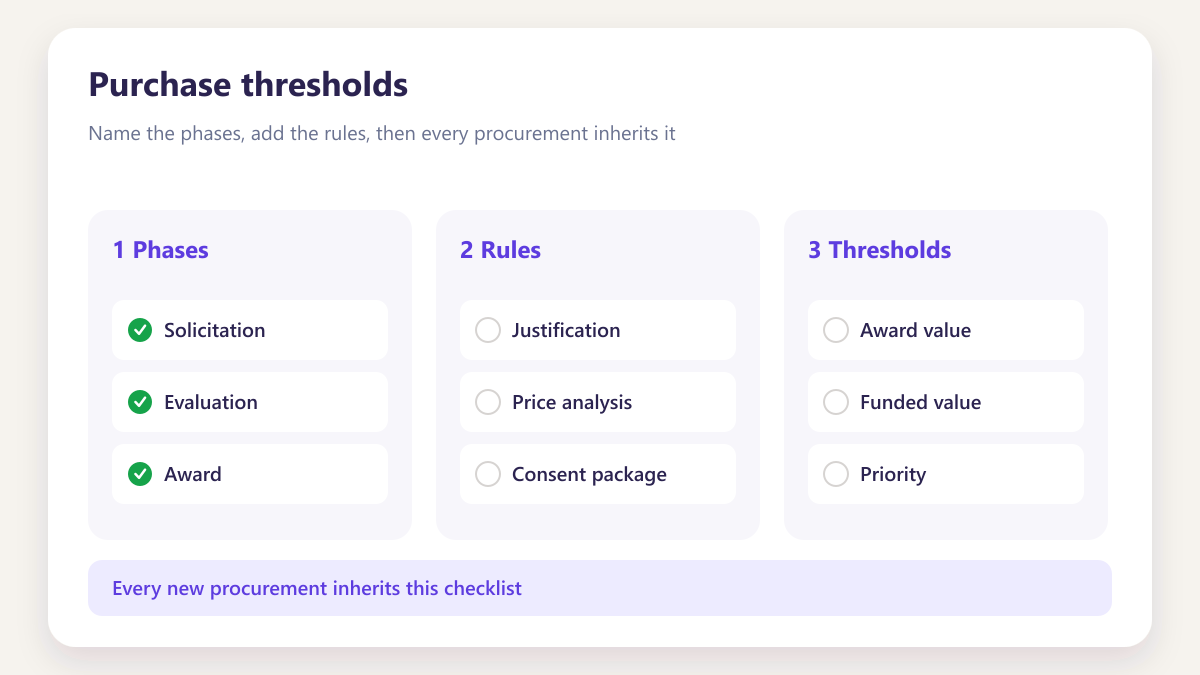
Purchase thresholds
Micro-purchase and simplified acquisition figures, and what changes at each.
Learn more
See what a purchase file can hold
Bring an award you would rather not have sampled. We will show what the record would contain if the reasoning had been captured at the decision.
Book a demo