Home / Solutions
SolutionsSame purchasing file,
very different pressure
A shipbuilder with one award and forty modifications has a different problem from an 8(a) firm carrying identical documentation expectations with four people. ProcureAudit is procurement compliance software built for both, because the record has the same shape even when the pressure does not.
Three outcomes every contractor asks for
The sector decides which of these hurts first. All three follow from one change, which is building the record as work happens rather than assembling it at the end.
Three outcomes every contractor asks for
The sector decides which of these hurts first. All three follow from one change, which is building the record as work happens rather than assembling it at the end.
- Files produced in an afternoon
- Gaps found while they are cheap
- Records that survive people leaving
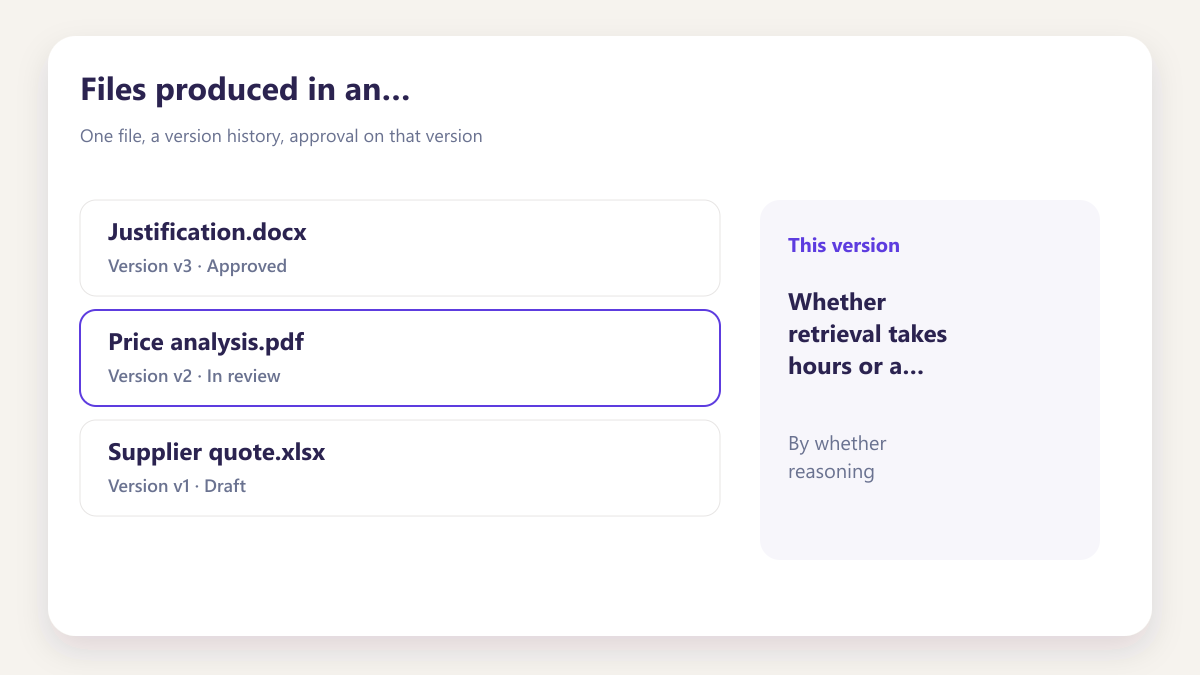
Files produced in an afternoon
Whether retrieval takes hours or a fortnight was settled months earlier, by whether reasoning and evidence were captured at the time or left to be reconstructed from memory.
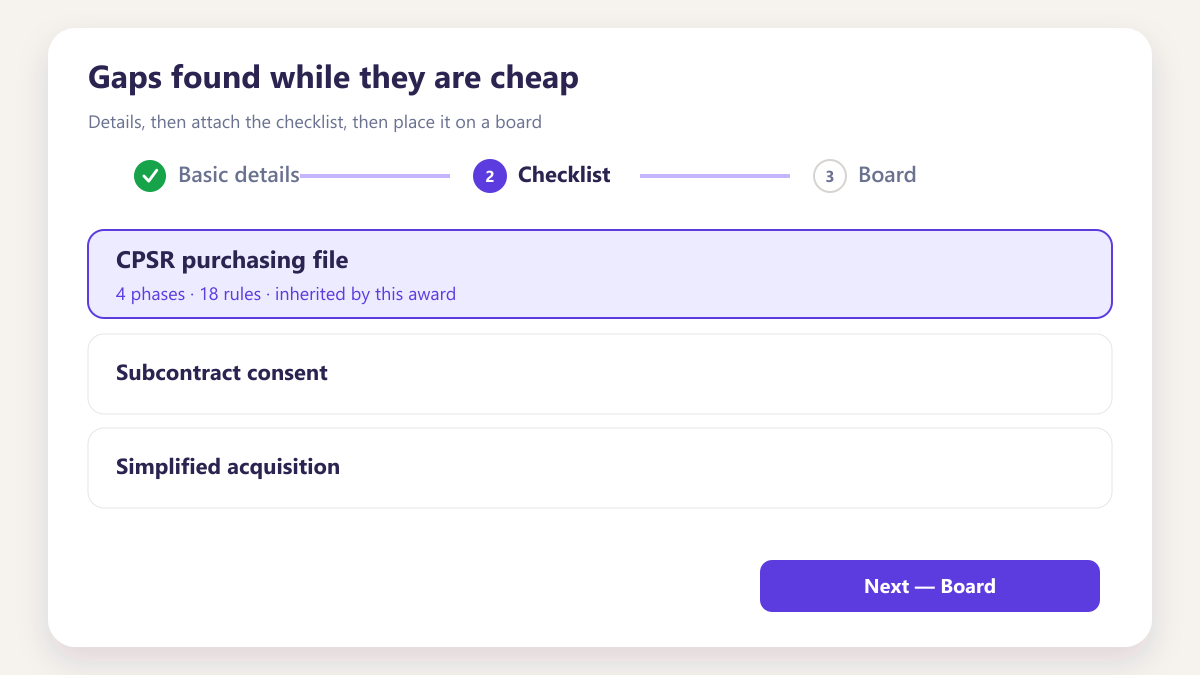
Gaps found while they are cheap
An award that stalled, a document never uploaded, a modification with no approval. Each is trivial to fix in week two and awkward to explain in year two.
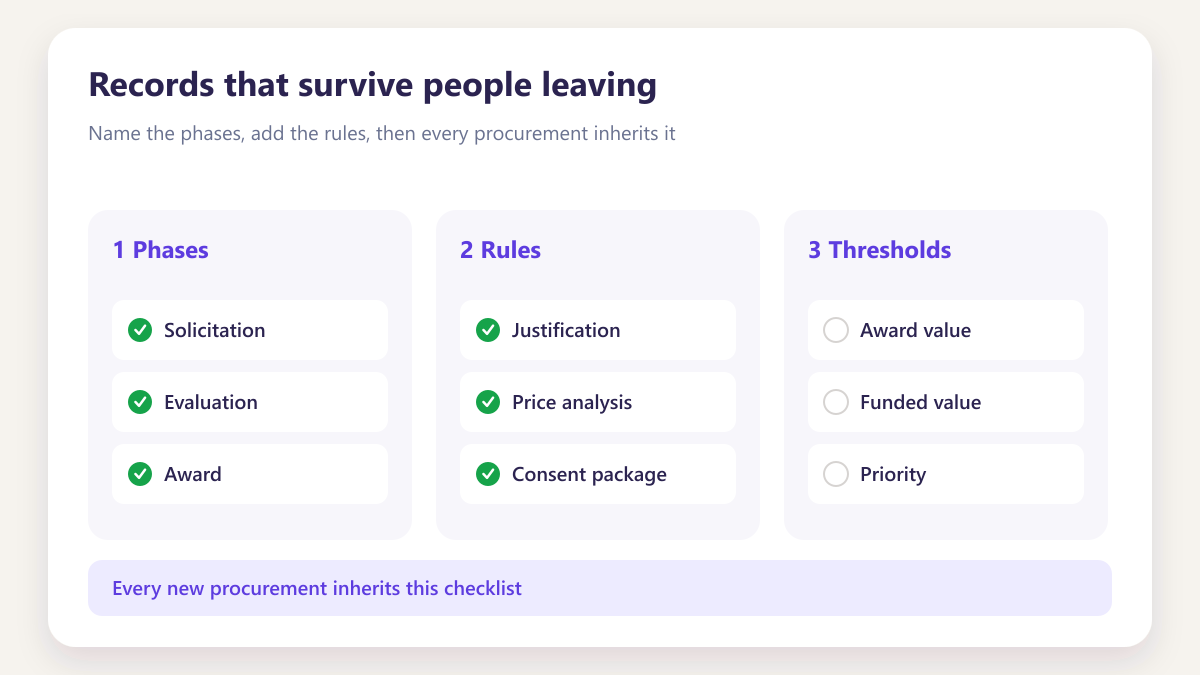
Records that survive people leaving
Purchasing files outlive staff. A record that depends on somebody explaining it degrades every time the team changes, which in most sectors is often.
Six problems contractors bring us, and what replaces them
Every sector describes these differently. Underneath, they are the same six failures.
Six problems contractors bring us, and what replaces them
Every sector describes these differently. Underneath, they are the same six failures.
- Producing the file is a project
- Nobody wrote down why
- Changes blur into the parent
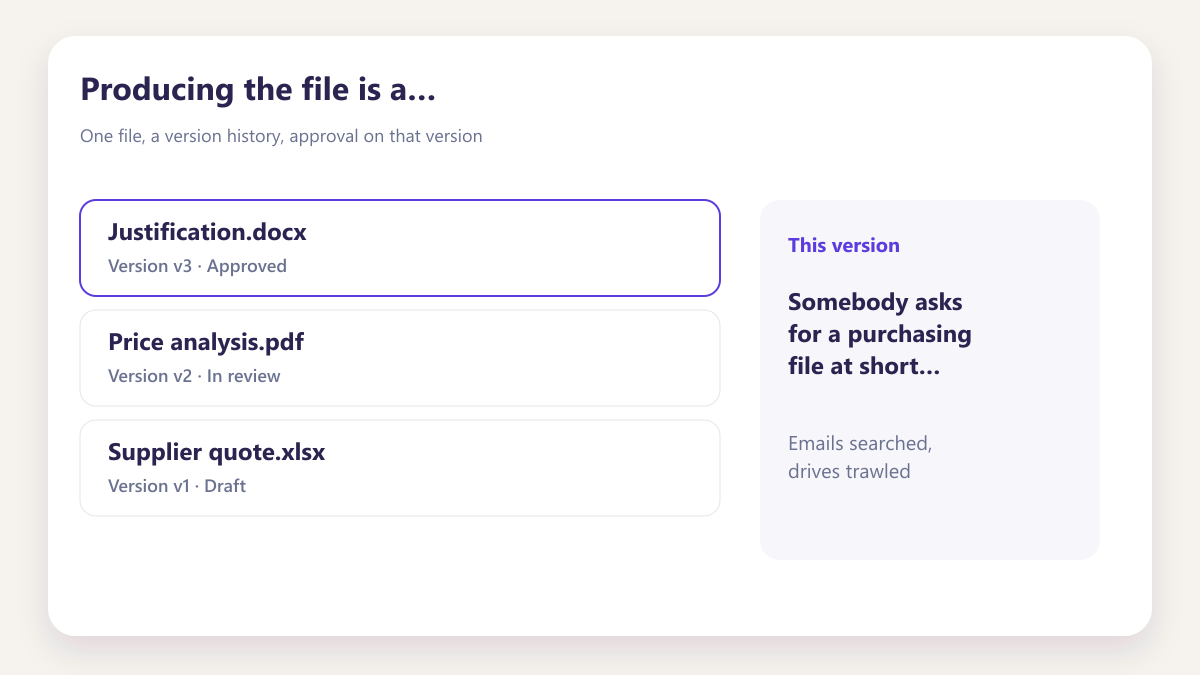
Producing the file is a project
Somebody asks for a purchasing file at short notice and the work becomes collection. Emails searched, drives trawled, colleagues asked to remember, and gaps discovered at the worst possible moment.
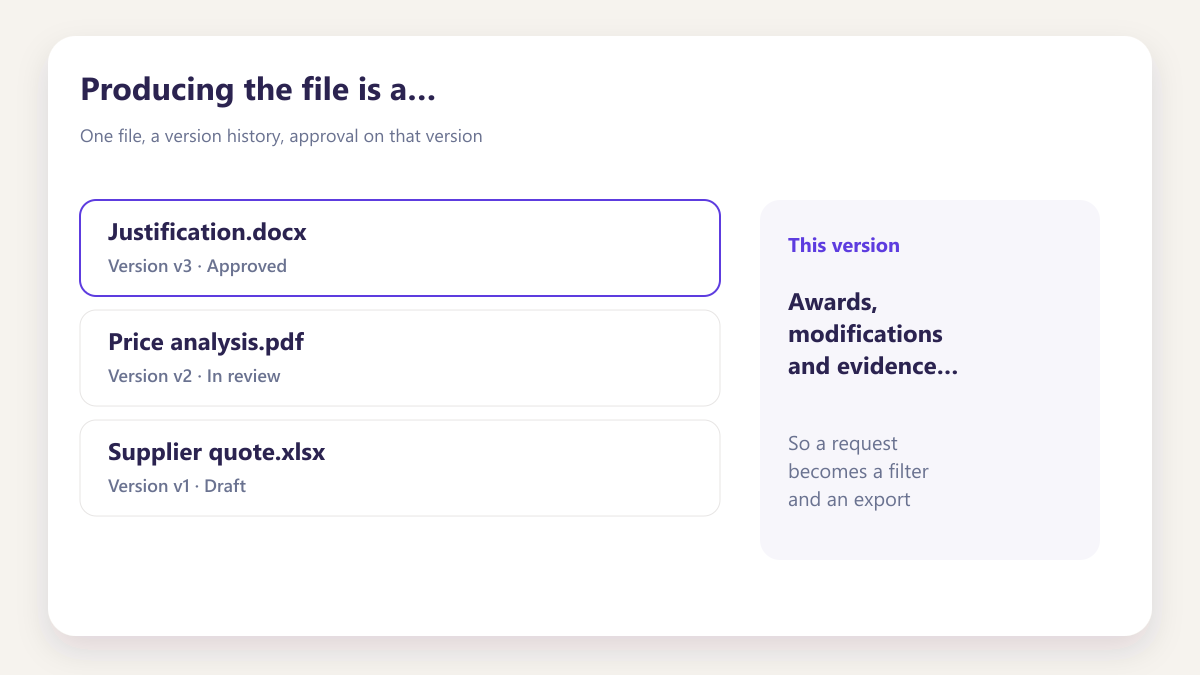
Producing the file is a search
Awards, modifications and evidence sit on one record, so a request becomes a filter and an export rather than an appeal to everybody's inbox.
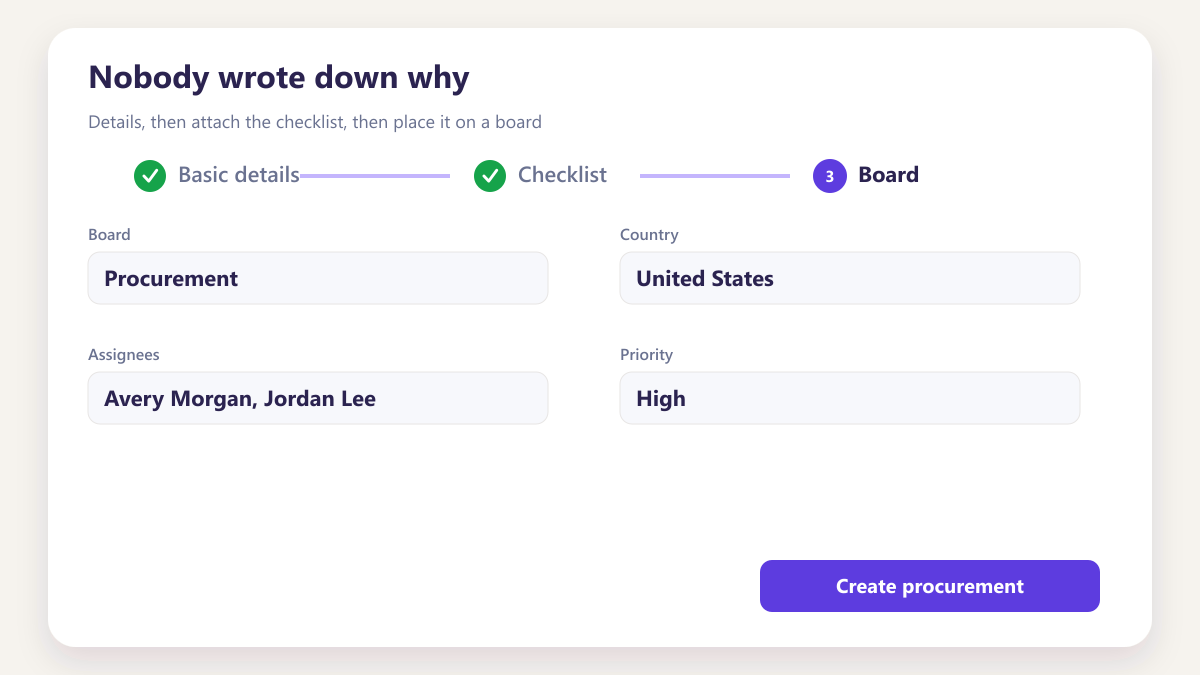
Nobody wrote down why
The decision was sound and the reasoning lived in a conversation. Prices and dates survive in documents, but why one supplier was chosen exists only if somebody captured it.
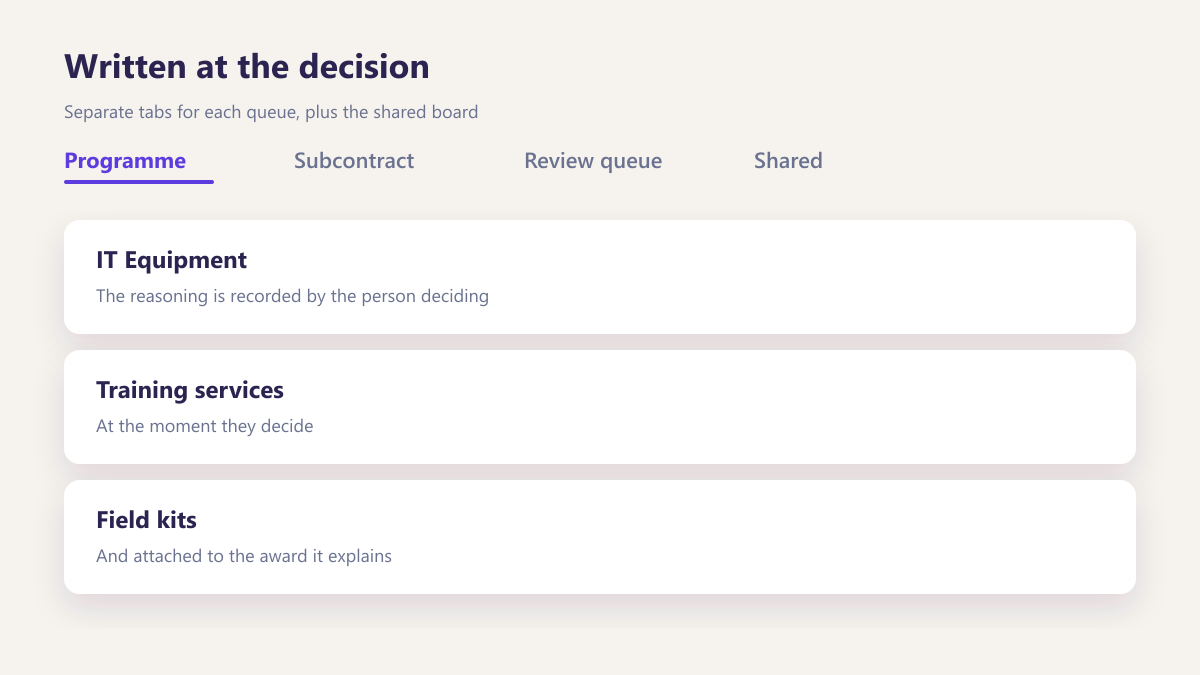
Written at the decision
The reasoning is recorded by the person deciding, at the moment they decide, and attached to the award it explains.
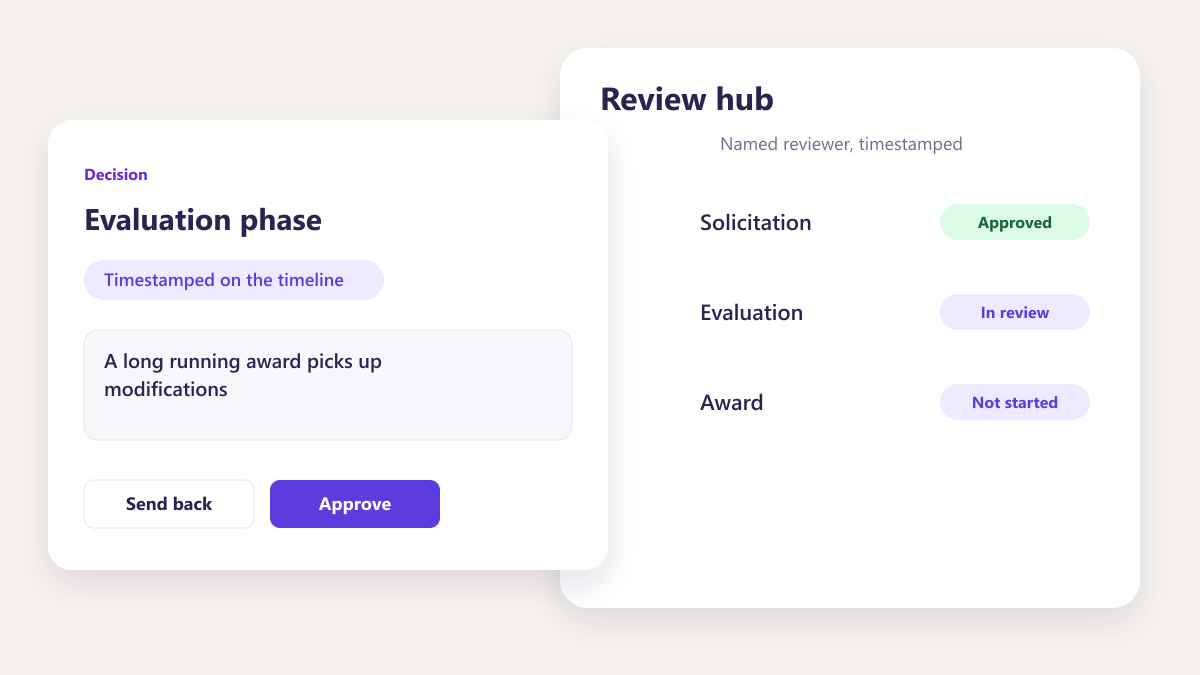
Changes blur into the parent
A long running award picks up modifications, and after the third it stops being clear which document supports which change. That ambiguity is where most retrieval problems begin.
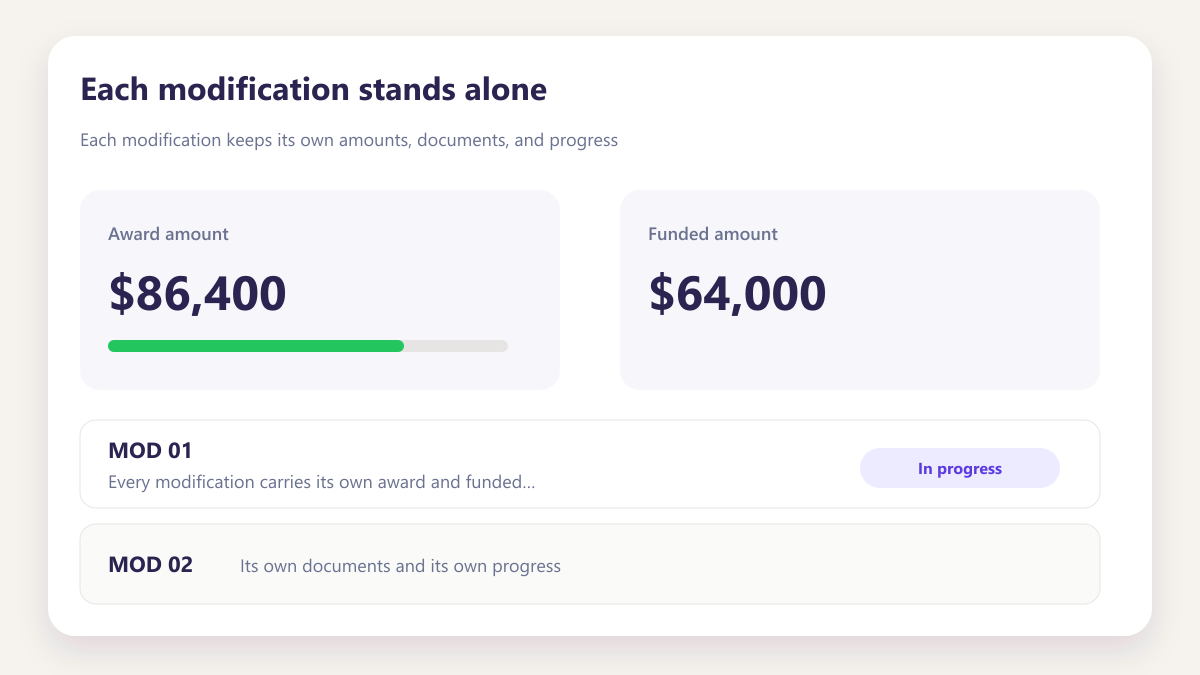
Each modification stands alone
Every modification carries its own award and funded amounts, its own documents and its own progress, however many accumulate over a program.
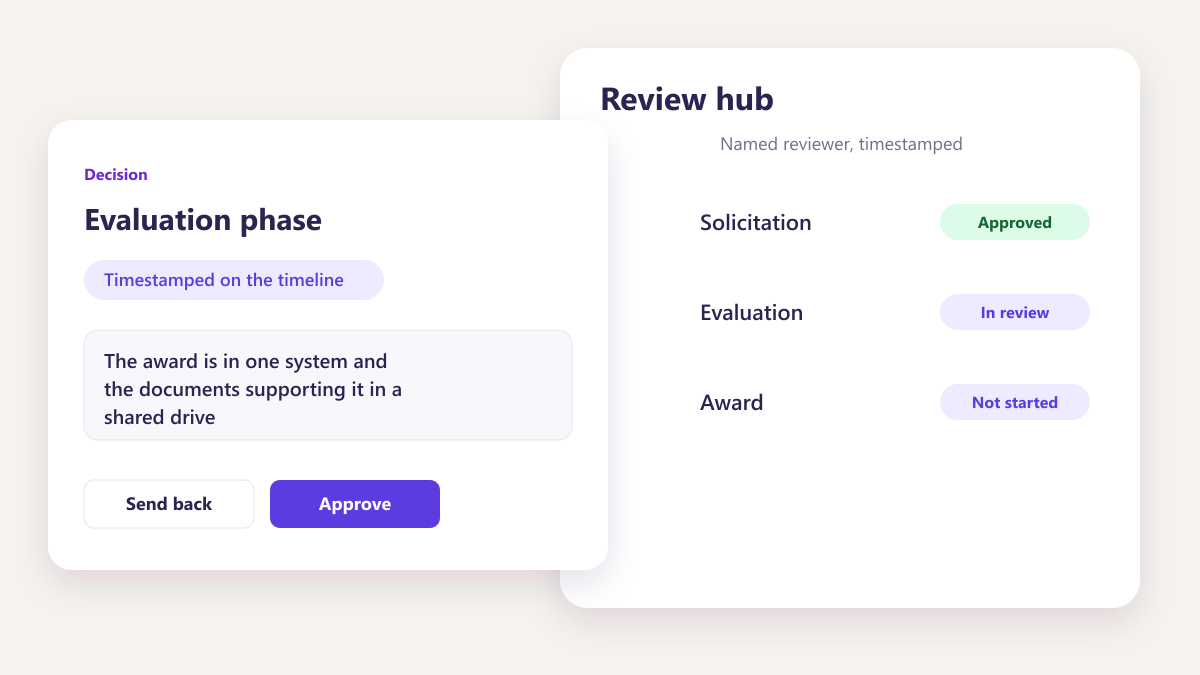
Evidence sits apart from the award
The award is in one system and the documents supporting it in a shared drive, connected by a naming convention somebody invented and nobody else fully understands.
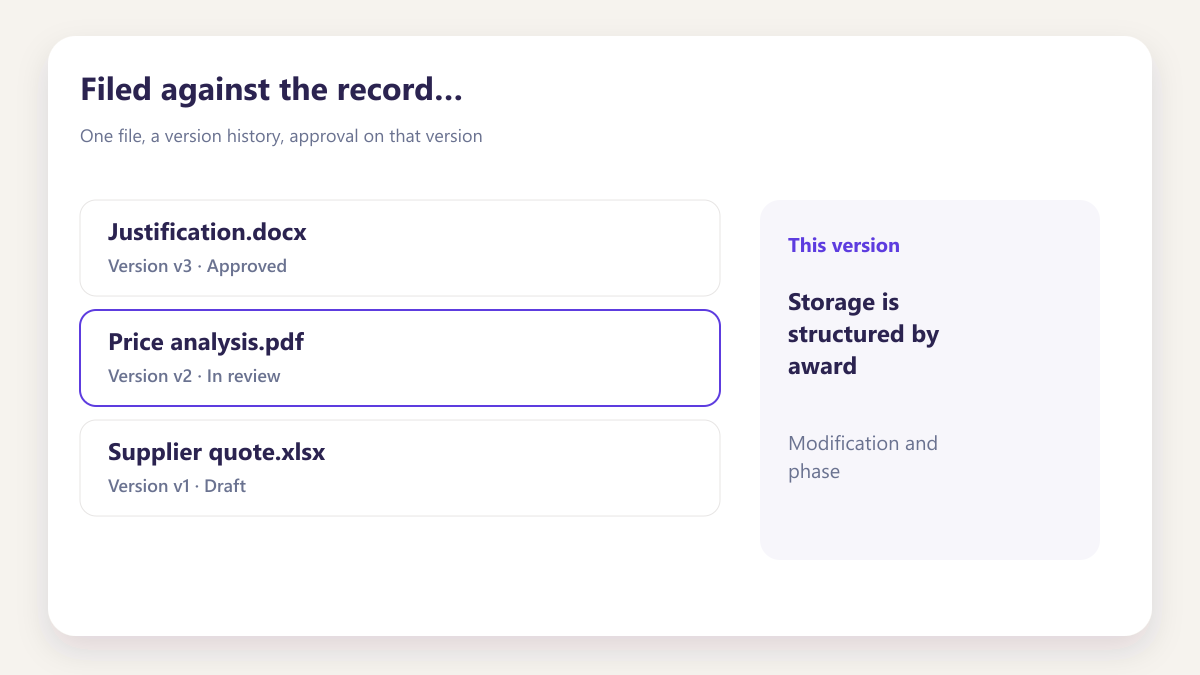
Filed against the record itself
Storage is structured by award, modification and phase, with version history retained and approval recorded against the version actually reviewed.
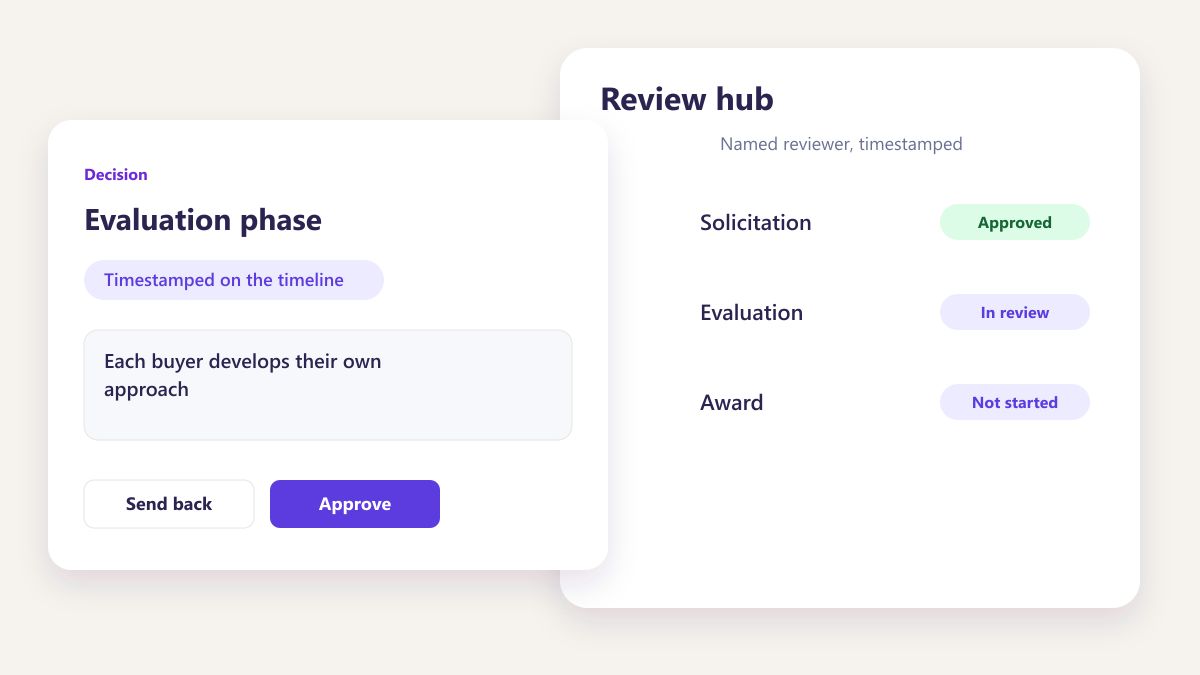
It depends on who is doing it
Each buyer develops their own approach, thresholds get applied when somebody remembers, and the quality of a file depends on who placed the award.
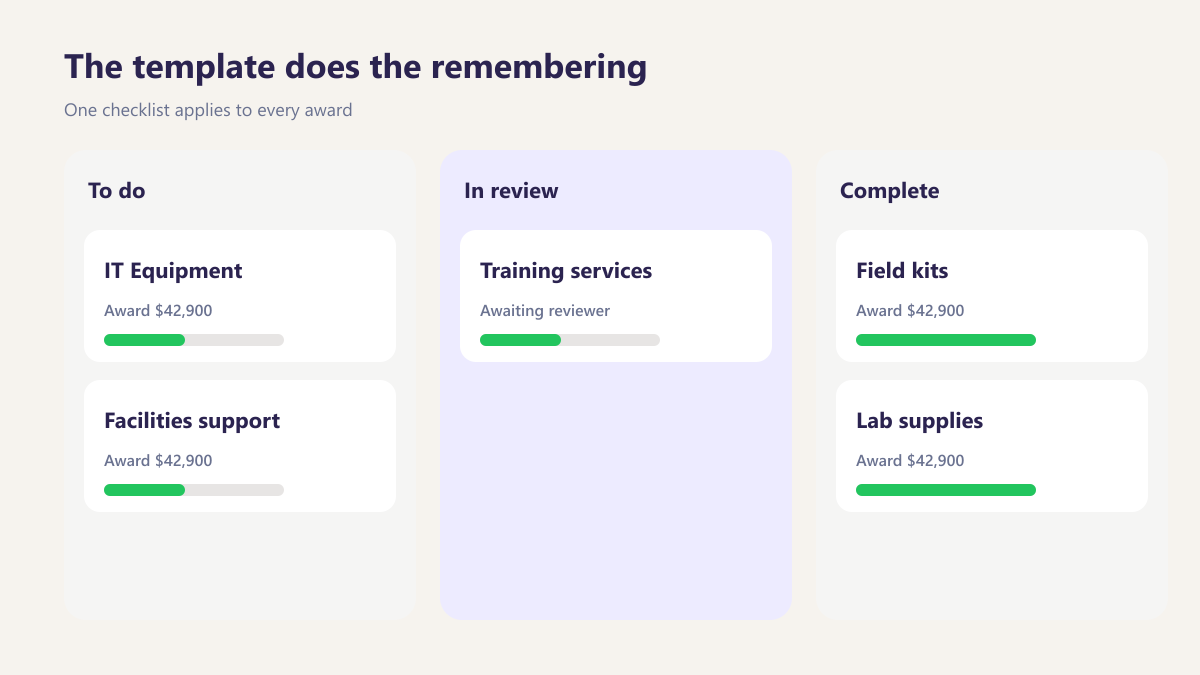
The template does the remembering
One checklist applies to every award, thresholds fire on the award value, and reviewers are assigned per phase in advance rather than picked each time.
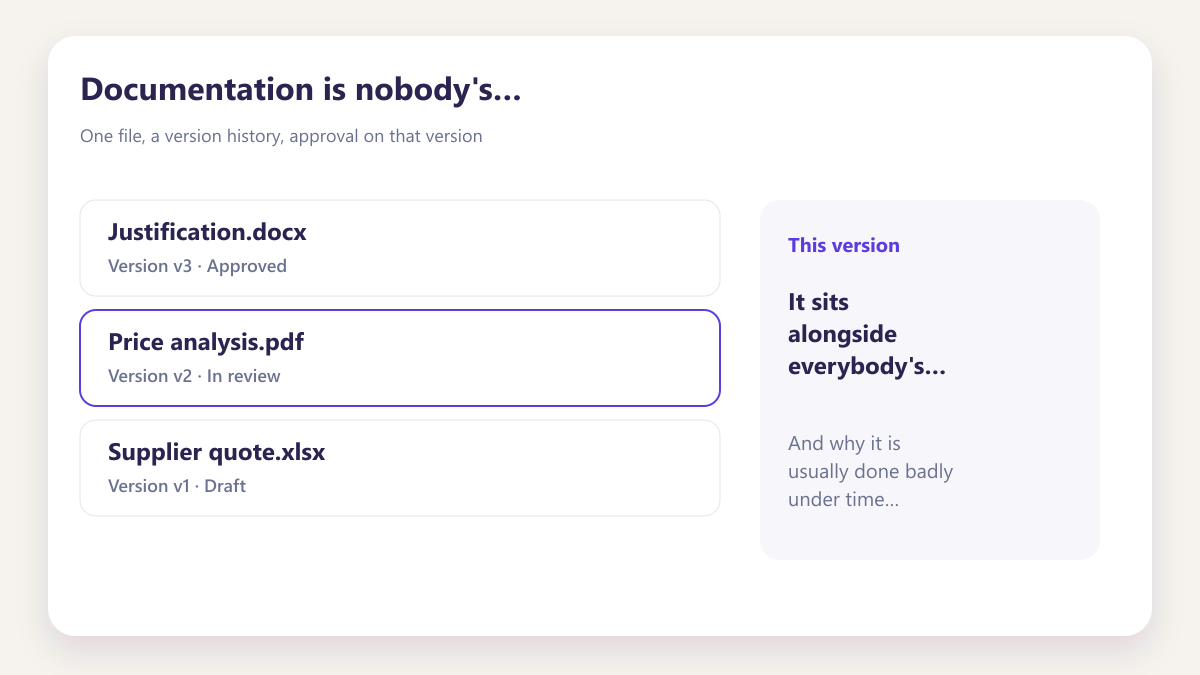
Documentation is nobody's actual job
It sits alongside everybody's real work, which is why it slips first whenever the real work gets busy, and why it is usually done badly under time pressure.
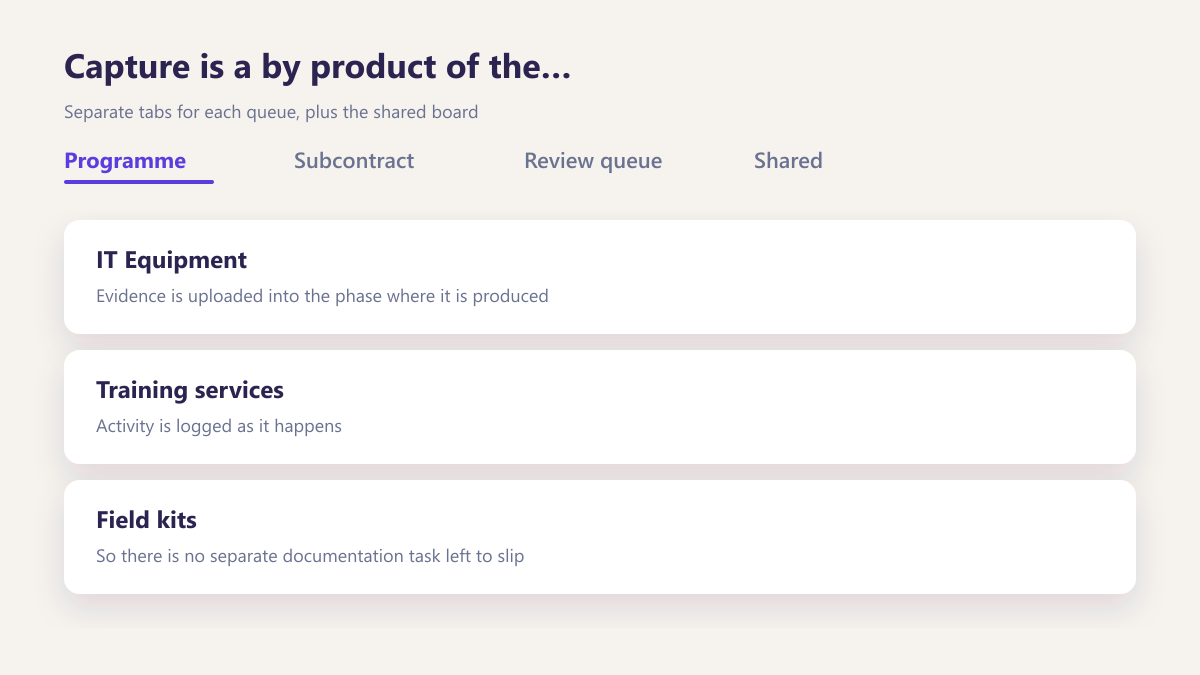
Capture is a by product of the work
Evidence is uploaded into the phase where it is produced and activity is logged as it happens, so there is no separate documentation task left to slip.
Six sectors we hear from most
The sectors that bring us the most conversations. Four more follow underneath.
Defense and DoD
Subcontract files that accumulate modifications for years and get read by people who were never involved.
Program teams change faster than awards close. Reasoning captured at the decision is the only version that still reads properly in year four, which is why defense contractors care more about capture than retrieval.
Learn moreAerospace and aviation
Long lead awards where certificates must be provable as they stood on the award date, not today.
A certificate renewed twice since the award does not answer whether it was valid when you bought. Keeping the state at award time alongside the current one is the distinction that matters here.
Learn moreIT and cybersecurity
Purchasing where the supply chain behind an award is examined as closely as the award itself.
What gets asked is whether the checks happened before you placed the award. Recording the check with the person and the date makes that a point in time answer rather than an assertion about today.
Learn moreHealthcare and life sciences
Federally funded purchasing where the money carries conditions on what may be bought and when.
Permitted use and eligible period are both knowable when a purchase is raised. Checking then is the only moment the answer can still change what happens, rather than surfacing during reporting.
Learn moreConstruction and engineering
Site purchasing where subcontractor documents expire quietly and variations get agreed verbally.
Two failures dominate here. A certificate that lapsed months ago, and extra scope agreed on site that disappeared into the original award and got argued about at final account.
Learn moreSmall business and 8(a)
Identical documentation expectations, carried by a team also doing three other jobs.
Nobody reduces what a purchasing file must contain because your team is small. The leverage is building the checklist once and letting documents be read into records rather than keyed in.
Learn moreProfessional services
Buying expertise rather than goods, which leaves far less to point at afterwards.
There is no delivery note on an engagement. The file rests entirely on the written scope, the agreed rate and the reasoning, which is why all three are captured at the point of engagement.
Learn moreLogistics and supply chain
High volume purchasing where quantity rather than complexity is what breaks the record.
Nothing is individually hard, which is precisely why it slips. Templates that apply themselves keep the marginal effort near zero, and exceptions surface rather than needing to be looked for.
Learn moreManufacturing and industrial base
Supplier relationships that last years, against awards that turn over constantly.
Holding supplier documents once rather than per award removes the duplicated chasing, while awards inherit their template on creation so repeat buying stays documented through a busy quarter.
Learn moreShipbuilding and maritime
Multi year vessel programs where a single award can span dozens of modifications.
Learn moreEnergy and environmental services
Field and remediation work where purchasing happens a long way from any desk.
Learn moreResearch and universities
Federally funded research purchasing, split across awards that each carry their own conditions.
Learn moreFacilities and base operations
Recurring service awards where subcontractors stay on site continuously and nothing ever really closes.
Learn moreWritten for the person, not the organisation
What a compliance officer needs from a purchasing record is not what a program manager needs, so each role has its own page.
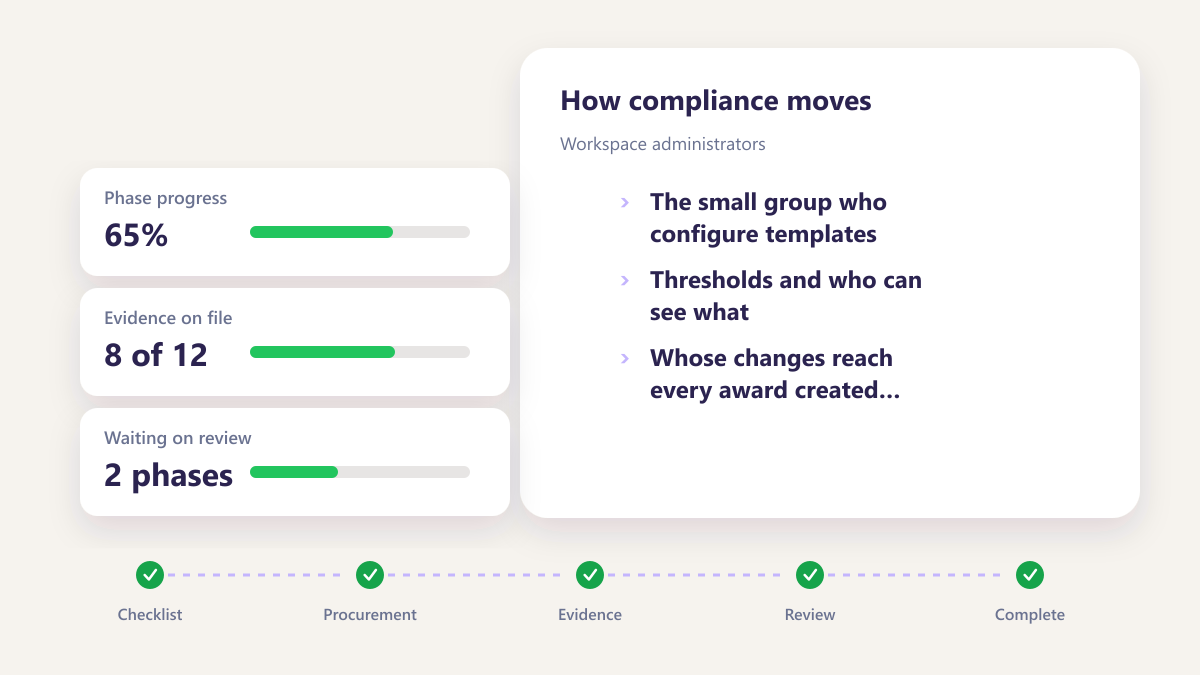
Workspace administrators
The small group who configure templates, thresholds and who can see what, whose changes reach every award created afterwards.
Learn more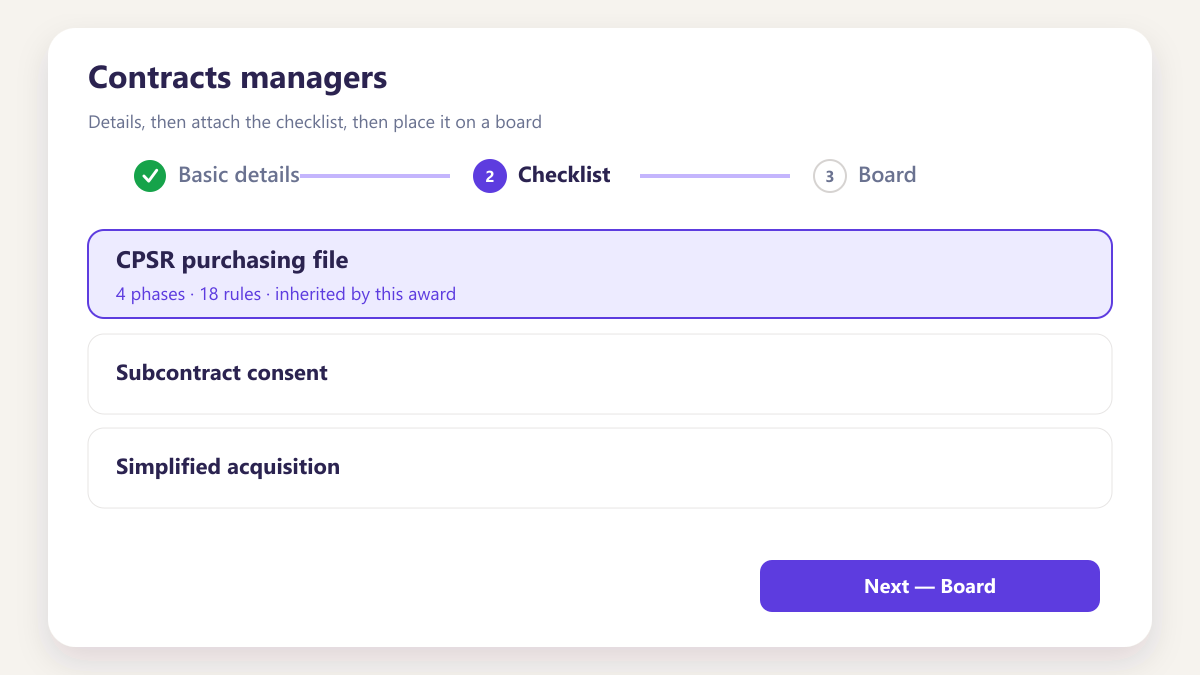
Contracts managers
Producing the purchasing file, usually at short notice and usually about work somebody else did.
Learn more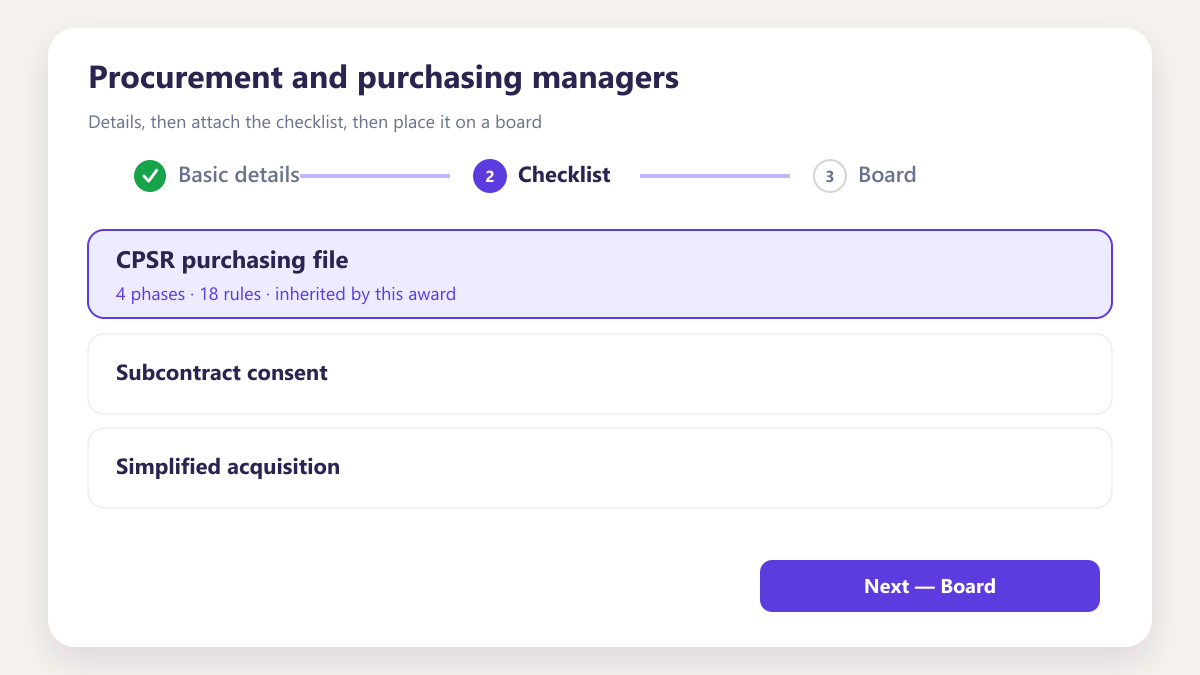
Procurement and purchasing managers
Running the buying while keeping the record complete as it happens rather than afterwards.
Learn more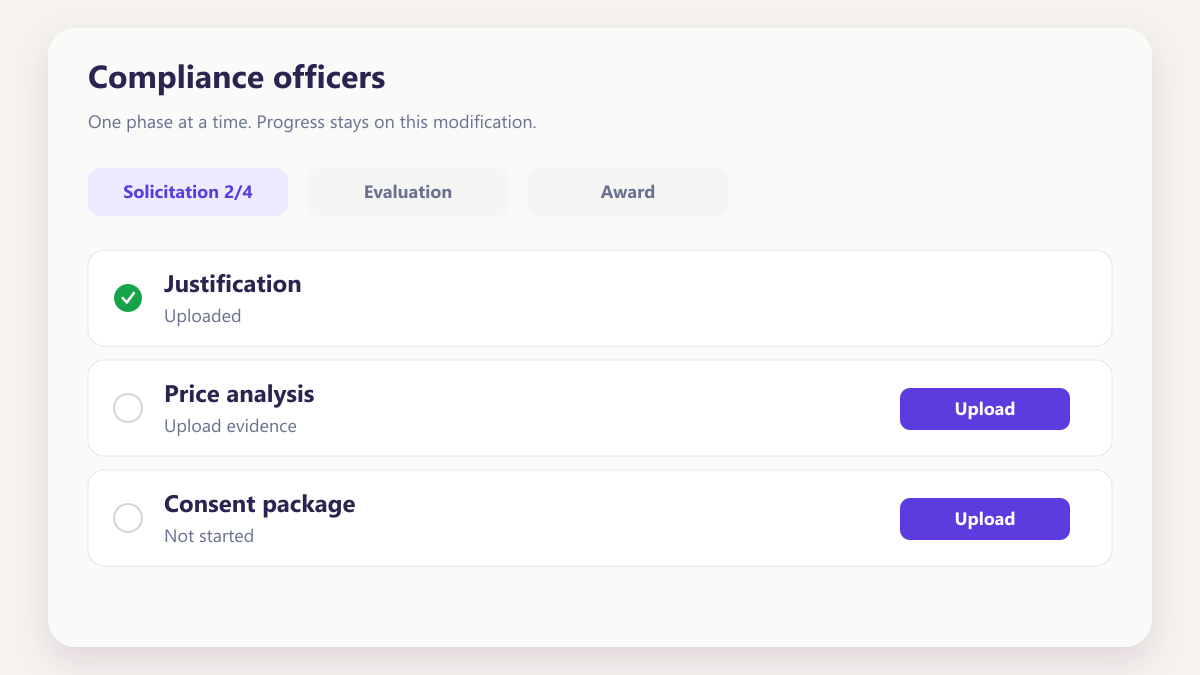
Compliance officers
Checking a team you cannot watch transaction by transaction, where consistency matters more than inspection.
Learn more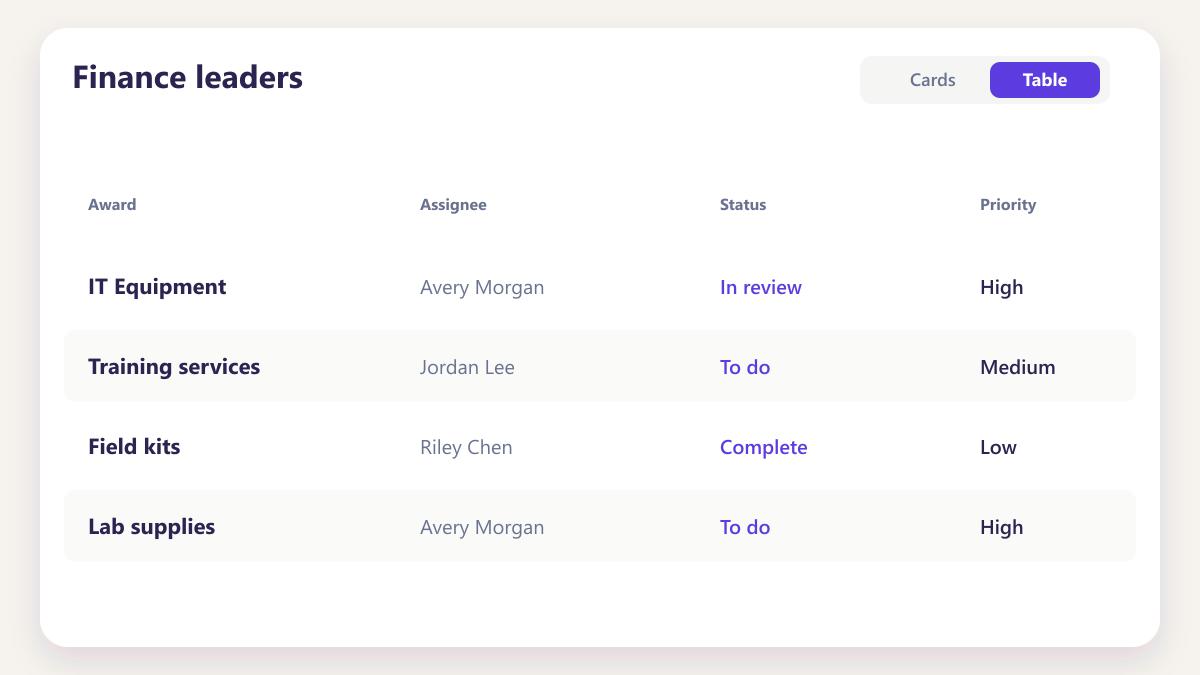
Finance leaders
Award against funded amounts per modification, so incremental funding gaps stay visible.
Learn more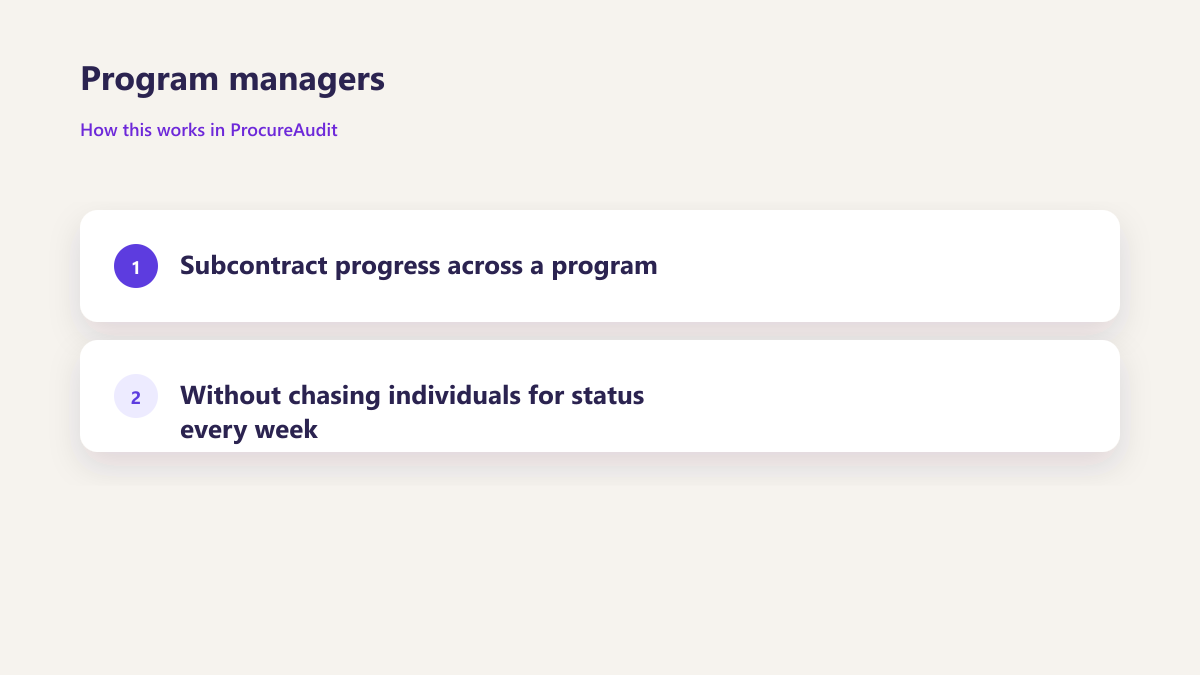
Program managers
Subcontract progress across a program, without chasing individuals for status every week.
Learn more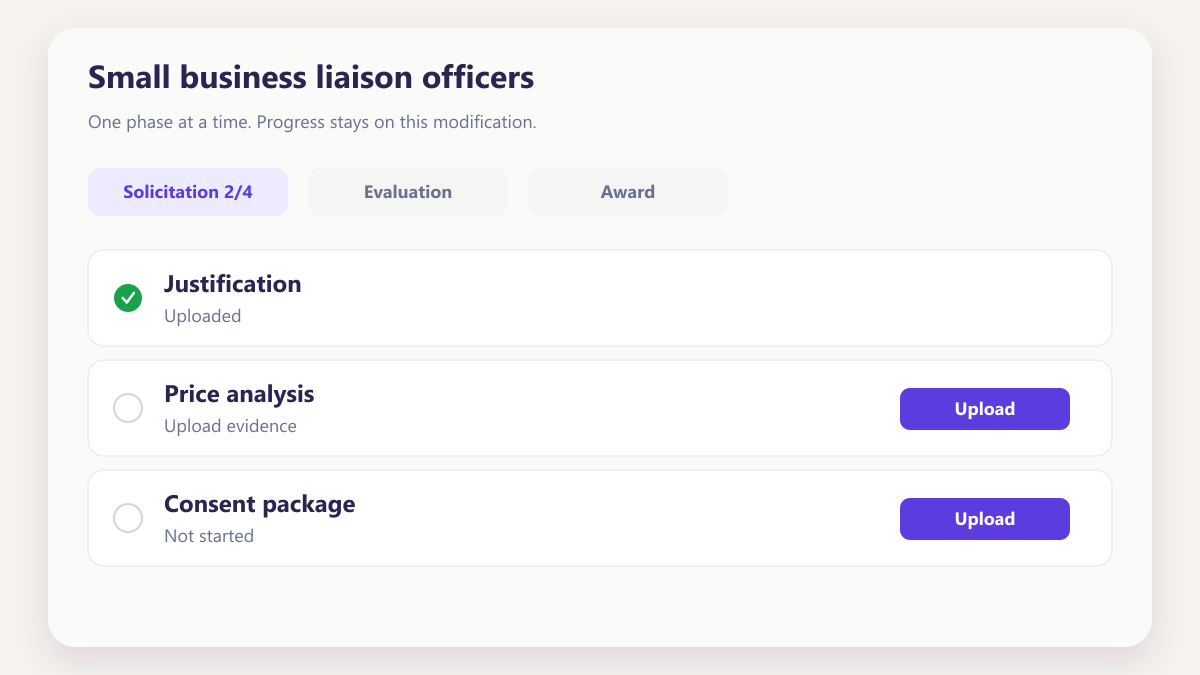
Small business liaison officers
Subcontracting participation evidenced from records rather than estimated at reporting time.
Learn more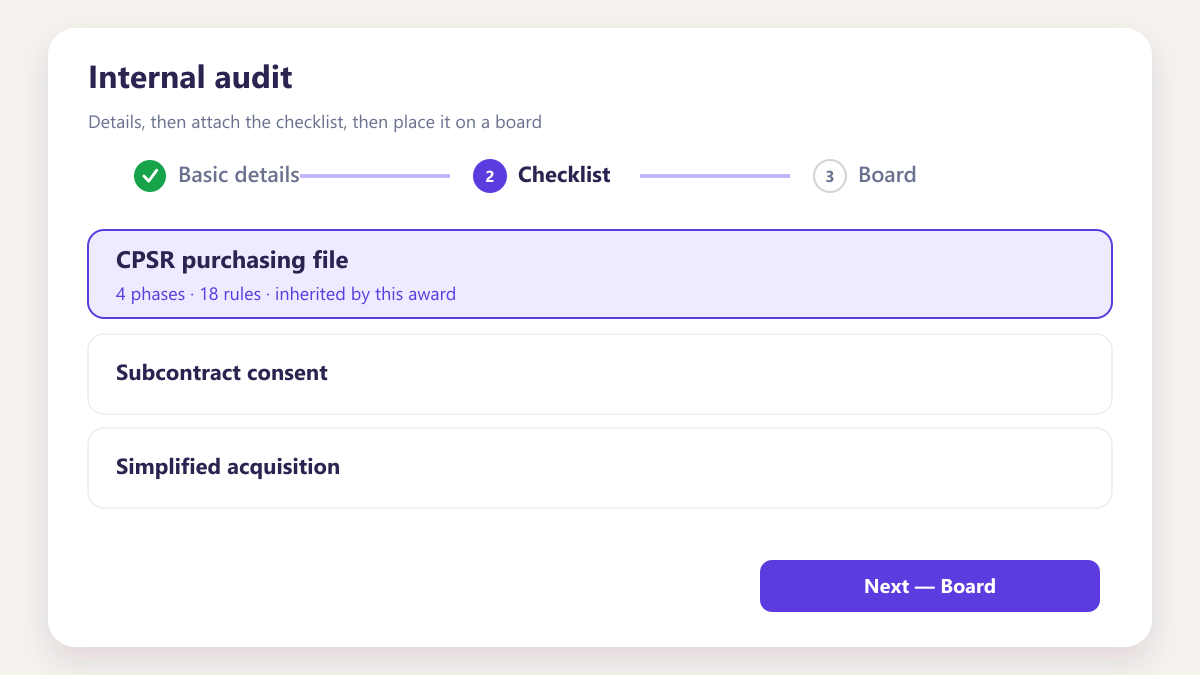
Internal audit
Sampling a population and getting the supporting evidence without launching a collection exercise.
Learn more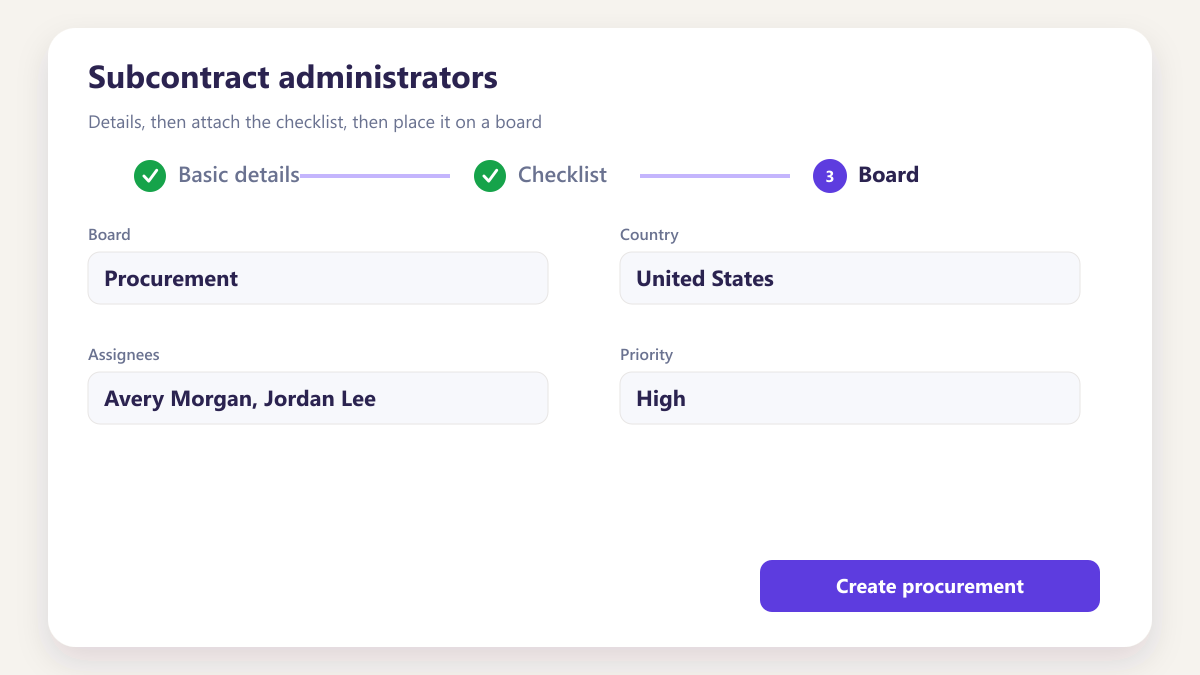
Subcontract administrators
Keeping modification records, flow downs and supplier documents current across a live program.
Learn moreMost contractors are both, and that is fine
The obligations flow in different directions. The record you have to produce has the same shape either way.
Writing for people who build purchasing files
Practical pieces on documentation, modifications and what a complete award record actually contains.
What belongs in a subcontract purchasing file
The six things a reviewer looks for, and why five of them are easier to capture at the time than to reconstruct.
Why modifications should never merge into the parent award
A single blended percentage hides which change the outstanding work belongs to, which is where most retrieval problems start.
Building a compliance checklist your team will actually follow
Phases people recognise, thresholds that fire on value, and reviewers assigned before anybody needs one.

ProcureAudit holds the contract file. eProcureAI runs the buying.
ProcureAudit is built by eProcureAI, alongside the main procurement platform and VendorHub. If your pressure is day to day purchasing rather than the contract record, the main platform covers requests, approvals, purchase orders, receiving and invoice matching, on the same principle of one record rather than four systems.
Explore eProcureAIQuestions about fit
Is ProcureAudit different by industry?
We are a prime on some work and a subcontractor on other work
Our industry is not listed
Should I read an industry page or a role page?
How long before it is useful?
Do we need a dedicated team to run it?
Can we start with a single program?
See it on one of your own awards
Bring a subcontract you would rather not assemble by hand, ideally one with a couple of modifications and a buyer who has since moved on.